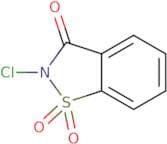
CAS 14070-51-0
:N-chlorosaccharin
Description:
N-chlorosaccharin, with the CAS number 14070-51-0, is a chlorinated derivative of saccharin, a widely used artificial sweetener. This compound is characterized by the presence of a chlorine atom attached to the nitrogen atom of the saccharin structure, which enhances its reactivity compared to its parent compound. N-chlorosaccharin is typically a white to off-white crystalline solid, exhibiting solubility in polar solvents such as water and alcohols. It is known for its applications in organic synthesis, particularly as a chlorinating agent, and may also possess antimicrobial properties. The compound's stability can vary depending on environmental conditions, such as pH and temperature, which can influence its reactivity and potential applications. As with many chlorinated compounds, safety precautions should be observed due to potential toxicity and environmental concerns. Overall, N-chlorosaccharin serves as an interesting example of how modifications to a well-known compound can lead to new chemical properties and applications.
Formula:C7H4ClNO3S
InChI:InChI=1/C7H4ClNO3S/c8-9-7(10)5-3-1-2-4-6(5)13(9,11)12/h1-4H
SMILES:c1ccc2c(c1)C(=O)N(Cl)S2(=O)=O
Synonyms:- 2-chloro-1,2-benzisothiazol-3(2H)-one 1,1-dioxide
Sort by
Purity (%)
0
100
|
0
|
50
|
90
|
95
|
100
Found 5 products.
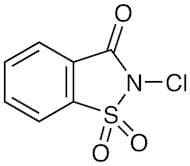
N-Chlorosaccharin
CAS:Formula:C7H4ClNO3SPurity:>96.0%(T)Color and Shape:White to Almost white powder to crystalineMolecular weight:217.621,2-Benzisothiazol-3(2H)-one, 2-chloro-, 1,1-dioxide
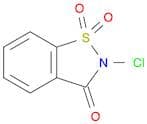
CAS:Formula:C7H4ClNO3SPurity:95%Color and Shape:SolidMolecular weight:217.62962-Chlorobenzo[d]isothiazol-3(2H)-one 1,1-dioxide
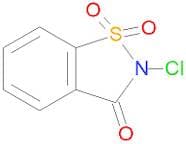
CAS:Formula:C7H4ClNO3SPurity:95%Color and Shape:Solid, No data available.Molecular weight:217.62N-Chlorosaccharin
CAS:N-Chlorosaccharin is a type strain of the bacterial strain Bacillus licheniformis. It is used in the production of aspartame and other sweeteners, and can be found in diabetic patients. N-chlorosaccharin is produced by hydrolysis of saccharin, which is synthesized from methyl ethyl sulfonate (MES) and sulfamoyl chloride. This chemical has kinetic data that can be analyzed using logistic regression to determine its kinetics. The rate of reaction increases with increasing temperature and pH, but decreases with increasing concentrations of MES or phosphotungstic acid. In addition, it has been shown that mutants are more sensitive to this chemical than the wild type strain.Formula:C7H4ClNO3SPurity:Min. 95%Molecular weight:217.63 g/mol



![2-Chlorobenzo[d]isothiazol-3(2H)-one 1,1-dioxide](/_next/image/?url=https%3A%2Fstatic.cymitquimica.com%2Fproducts%2F10%2Fthumb%2FF053895.jpg&w=3840&q=75)