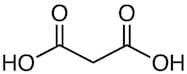
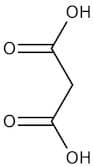
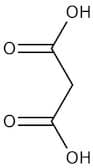
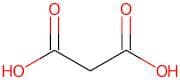
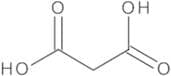
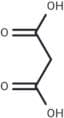
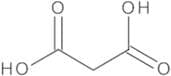
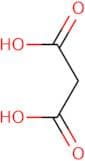
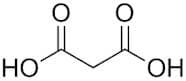
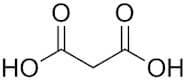
CAS 141-82-2
:Propanedioic acid
Description:
Propanedioic acid, commonly known as malonic acid, is a dicarboxylic acid characterized by its two carboxyl functional groups (-COOH) attached to a three-carbon chain. It appears as a white crystalline solid and is soluble in water, ethanol, and ether, making it versatile in various chemical applications. Malonic acid has a melting point that allows it to exist as a solid at room temperature, and it exhibits a slightly acidic nature, with a pKa value indicating its ability to donate protons in solution. This compound is significant in organic synthesis, particularly in the preparation of various esters and as a building block in the synthesis of larger molecules, including pharmaceuticals and agrochemicals. Additionally, malonic acid plays a role in biological systems, particularly in the citric acid cycle, where it can act as an intermediate. Its CAS number, 141-82-2, is used for identification in chemical databases, ensuring precise communication in scientific literature and industry.
Formula:C3H4O4
InChI:InChI=1/C3H4O4/c4-2(5)1-3(6)7/h1H2,(H,4,5)(H,6,7)/p-2
InChI key:InChIKey=OFOBLEOULBTSOW-UHFFFAOYSA-N
SMILES:C(C(O)=O)C(O)=O
Synonyms:- 1,3-Propanedioic acid
- Acide malonique
- Acido Malonico
- Carboxyacetic acid
- Dicarboxymethane
- Malonates
- Malonic Acid
- Malonsaeure
- Malonsaure
- Methanedicarboxylic acid
- Nsc 8124
- Methanadicarboxylic acid
- Propanedioic acid
- Methane dicardonic acid
- propanedioate
- CH2(COOH)2
- Methanadicarboxylicacid
- MALONATE ION CHROMATOGRAPHY STANDARD
- kyselinamalonova
- DICARBOXYLIC ACID CO
- USAF ek-695
- Methanedicarbonic acid
- Methane acid
- MAAC
- AKOS BBS-00003780
- MALONIC ACID FREE ACID
- Methanedicardonicacid
- Kyselina malonova
- usafek-695
- See more synonyms
Sort by
Purity (%)
0
100
|
0
|
50
|
90
|
95
|
100
Found 15 products.
Malonic Acid
CAS:Formula:C3H4O4Purity:>99.0%(T)Color and Shape:White to Almost white powder to crystalMolecular weight:104.06Malonic acid, Reagent Grade, 99.5+%
CAS:Malonic acid is used to prepare barbiturates. Its derivative diethylmalonate is used in Knoevenagel condensation reactions as well as reacts with acetone to form Meldrum's acid. It is used to control acidity, preservative additive for foods and as an excipient in pharmaceutical formulation. It acts
Formula:C3H4O4Purity:99.5+%Color and Shape:White, Crystals or powder or crystalline powderMolecular weight:104.06Malonic acid, 99%
CAS:Malonic acid is acts as a building block in organic synthesis. It is also useful as a precursor for polyesters and alkyd resins, which is used in coating applications, thereby protecting against UV light, corrosion and oxidation. It acts as a cross linker in the coating industry and surgical adhesiFormula:C3H4O4Purity:99%Color and Shape:White, Crystals or powder or crystalline powder or granulesMolecular weight:104.06Malonic acid
CAS:Malonic acidFormula:C3H4O4Purity:≥95%Color and Shape: white crystalline powderMolecular weight:104.06146g/molMalonic acid
CAS:Formula:C3H4O4Purity:(Titration) 99.0 - 101.0 % (dried basis)Color and Shape:White crystalline powder or crystalsMolecular weight:104.06Malonic acid
CAS:Formula:C3H4O4Purity:95.0%Color and Shape:Solid, White solidMolecular weight:104.061Malonic acid
CAS:Malonic acid inhibits succinate dehydrogenase; linked to malonyl-CoA decarboxylase deficiency.Formula:C3H4O4Purity:99.53%Color and Shape:SoildMolecular weight:104.06Malonic Acid
CAS:Controlled ProductApplications Malonic Acid, is a small bioactive molecule, that can be used in variuos reactions. It is the classic example of a competitive inhibitor, which acts against succinate dehydrogenase (complex II) in the respiratory electron transport chain.
References Weiner, N., "Malonic acid", Org. Synth.; Coll. Vol. 2: 376;Formula:C3H4O4Color and Shape:WhiteMolecular weight:104.06Malonic acid
CAS:Malonic acid is a potent inducer of biocompatible polymers and sodium salts. It is an acidic chemical compound that belongs to the group of malonates. Malonic acid has been shown to induce neuronal death in model systems, but also has a protective effect on human serum fibroblasts. The reaction solution containing malonic acid and sodium bicarbonate generates malonate, which can be used as a precursor for energy metabolism and cell signaling.Formula:C3H4O4Color and Shape:White Off-White PowderMolecular weight:104.06 g/molMalonic Acid pure, 99%
CAS:Formula:C3H4O4Purity:min. 99%Color and Shape:White, Crystalline powder, Clear, ColourlessMolecular weight:104.06Malonic Acid extrapure AR, 99%
CAS:Formula:C3H4O4Purity:min. 99%Color and Shape:White, Crystalline powder, Clear, ColourlessMolecular weight:104.06