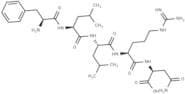
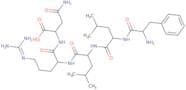
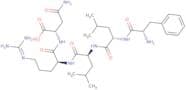
CAS 141136-84-7
:H-Phe-Leu-Leu-Arg-Asn-OH
Description:
The chemical substance with the name "H-Phe-Leu-Leu-Arg-Asn-OH" and CAS number "141136-84-7" is a peptide, specifically a pentapeptide composed of five amino acids: phenylalanine (Phe), leucine (Leu), arginine (Arg), and asparagine (Asn). This peptide is characterized by its sequence, which influences its biological activity and properties. The presence of the amino acids contributes to its hydrophobic and hydrophilic characteristics, affecting solubility and interaction with biological membranes. The terminal "H" indicates that it is in its free acid form, while "OH" suggests a carboxylic acid group at the end of the peptide chain. Peptides like this one can play significant roles in various biological processes, including signaling pathways and immune responses. They may also have potential therapeutic applications, such as in drug development or as biomarkers. The specific properties, such as stability, reactivity, and biological activity, can vary based on the peptide's structure and the environment in which it is studied.
Formula:C31H51N9O7
InChI:InChI=1/C31H51N9O7/c1-17(2)13-22(38-26(42)20(32)15-19-9-6-5-7-10-19)29(45)39-23(14-18(3)4)28(44)37-21(11-8-12-36-31(34)35)27(43)40-24(30(46)47)16-25(33)41/h5-7,9-10,17-18,20-24H,8,11-16,32H2,1-4H3,(H2,33,41)(H,37,44)(H,38,42)(H,39,45)(H,40,43)(H,46,47)(H4,34,35,36)
SMILES:CC(C)CC(C(=NC(CC(C)C)C(=NC(CCCNC(=N)N)C(=NC(CC(=N)O)C(=O)O)O)O)O)N=C(C(Cc1ccccc1)N)O
Synonyms:- H 8325
- Fllrn
- Phe-leu-leu-arg-asn
- Phenylalanyl-leucyl-leucyl-arginyl-asparagine
- L-Asparagine, N2-(N2-(N-(N-L-phenylalanyl-L-leucyl)-L-leucyl)-L-arginyl)-
Sort by
Purity (%)
0
100
|
0
|
50
|
90
|
95
|
100
Found 3 products.
FLLRN
CAS:FLLRN is a biologically active peptide serving as a PAR1-specific antagonist.Formula:C31H51N9O7Color and Shape:SolidMolecular weight:661.79H-Phe-Leu-Leu-Arg-Asn-OH
CAS:H-Phe-Leu-Leu-Arg-Asn-OH is a β-amino acid that has been shown to have antioxidant properties. It acts as a competitive inhibitor of the enzyme collagenase and has been shown to inhibit the development of atherosclerotic lesions in mice. The amide form of H-Phe-Leu-Leu-Arg-Asn has also been shown to have site specific activity on ventricular myocardium cells, which may be related to its ability to induce cytosolic calcium release. HPLR also has protease activity that can be inhibited by urea nitrogen and β amino acid. Basophilic leukemia cells produce HPLR at high levels and it is thought that this is due to an increased requirement for the production of collagen in these cells. HPLR has been shown to activate thrombin receptors, which are found on the surface of platelets and endothelial cells. Activated thrombinFormula:C31H51N9O7Purity:Min. 95%Molecular weight:661.81 g/molTRAP-6 (2-6) trifluoroacetate salt
CAS:TRAP-6 (2-6) is a monoclonal antibody that binds to the enzyme collagenase, which is an important factor in tumor invasion and metastasis. The antibody binds to the active site of collagenase, thereby inhibiting its activity. TRAP-6 (2-6) has been shown to reduce the growth of cancer cells by inhibiting the production of β-amino acids and zymogens, which are required for tumor cell proliferation. It also inhibits serine proteases, such as thrombin receptor, which play an important role in tumor invasion and metastasis. TRAP-6 (2-6) also has anti-inflammatory properties and can be used for the treatment of basophilic leukemia.Formula:C31H51N9O7Purity:Min. 95%Molecular weight:661.79 g/mol