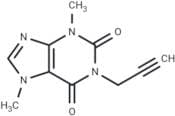
CAS 14114-46-6
:3,7-Dimethyl-1-propargylxanthine
Description:
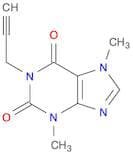
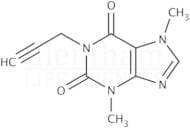
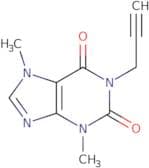
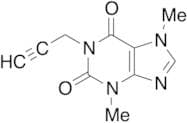
3,7-Dimethyl-1-propargylxanthine, with the CAS number 14114-46-6, is a xanthine derivative that exhibits structural modifications typical of this class of compounds. It features a xanthine backbone, which is characterized by a fused bicyclic structure containing nitrogen atoms. The presence of two methyl groups at the 3 and 7 positions, along with a propargyl group at the 1 position, contributes to its unique chemical properties and biological activity. This compound is known for its potential as a phosphodiesterase inhibitor, which can influence cellular signaling pathways by increasing levels of cyclic nucleotides. As a result, it may have implications in various therapeutic areas, including cardiovascular and neurological disorders. The solubility and stability of 3,7-Dimethyl-1-propargylxanthine can vary depending on the solvent and conditions, which is important for its application in research and potential medicinal use. Overall, its structural characteristics and biological activity make it a compound of interest in pharmacological studies.
Formula:C10H10N4O2
InChI:InChI=1S/C10H10N4O2/c1-4-5-14-9(15)7-8(11-6-12(7)2)13(3)10(14)16/h1,6H,5H2,2-3H3
InChI key:InChIKey=IORPOFJLSIHJOG-UHFFFAOYSA-N
SMILES:O=C1C2=C(N(C)C(=O)N1CC#C)N=CN2C
Synonyms:- 1H-Purine-2,6-dione, 3,7-dihydro-3,7-dimethyl-1-(2-propynyl)-
- 3,7-Dihydro-3,7-dimethyl-1-(2-propyn-1-yl)-1H-purine-2,6-dione
- 3,7-Dimethyl-1-propargylxanthine
- 1H-Purine-2,6-dione, 3,7-dihydro-3,7-dimethyl-1-(2-propyn-1-yl)-
- Theobromine, 1-(2-propynyl)-
Sort by
Purity (%)
0
100
|
0
|
50
|
90
|
95
|
100
Found 6 products.
3,7-Dimethyl-1-Propargylxanthine
CAS:Formula:C10H10N4O2Purity:98%Color and Shape:SolidMolecular weight:218.21203,7-Dimethyl-1-propargylxanthine
CAS:Controlled Product3,7-Dimethyl-1-propargylxanthine is a cyclase inhibitor that has been shown to have pharmacological effects. It has been shown to be effective in vivo models of Parkinson's disease and has reduced locomotor activity. This drug also inhibits the production of adenosine and dopamine, leading to neuronal death. The 3,7-dimethyl-1-propargylxanthine shows high selectivity for adenosine A3 receptors and is an antagonist at these receptors. It prevents mitochondrial membrane potential from decreasing, which may be due to inhibition of the production of reactive oxygen species by mitochondria. 3,7-Dimethyl-1-propargylxanthine also inhibits platelet aggregation by blocking the activation of phospholipase C and enhances platelet aggregation by inhibiting phosphodiesterase activity.Formula:C10H10N4O2Purity:Min. 95%Color and Shape:PowderMolecular weight:218.21 g/mol3,7-Dimethyl-1-propargylxanthine
CAS:Controlled ProductApplications A selective A2 adenosine receptor antagonist. Pharmacology: Ki vs [3H]NECA at A2 receptors in rat striatal membranes: 11± 3 uM; Ki vs [3H]CHA at A1 receptors in rat cerebral cortical membranes: 45 ± 4 uM.
References Alfinito, P., et al.: J. Neurosci., 23, 10982 (2003), Golembiowska, K., et al.: Neuropharmacol., 47, 414 (2004), Solinas, M., et al.: Psychopharmacol., 179, 576 (2005), Panjehpour, M., et al.: Oncol. Res., 16, 575 (2007),Formula:C10H10N4O2Color and Shape:NeatMolecular weight:218.21DMPX
CAS:DMPX (3,7-Dimethyl-1-propargylxanthine) is a caffeine-like compound capable of crossing the blood-brain barrier. It serves as an A2-selective adenosine receptor (AR) antagonist, effectively and selectively blocking the hypothermia and behavioral inhibition induced by A2 adenosine receptor agonists, such as NECA. DMPX is utilized in research on diseases like Parkinson's disease.Formula:C10H10N4O2Color and Shape:SolidMolecular weight:218.212