CAS 14133-90-5
:4-Hydroxypropranolol hydrochloride
Description:
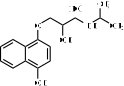
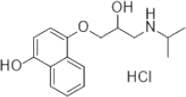
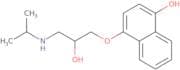
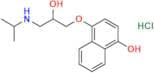
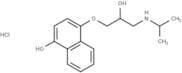
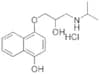
4-Hydroxypropranolol hydrochloride is a pharmaceutical compound that serves as a beta-blocker, primarily used in the treatment of cardiovascular conditions such as hypertension and anxiety. It is a derivative of propranolol, characterized by the presence of a hydroxyl group at the fourth position of the aromatic ring. This modification enhances its pharmacological properties. The compound is typically presented as a white to off-white crystalline powder, soluble in water and alcohol, which facilitates its administration in various formulations. Its molecular structure includes a naphthalene ring, an isopropanol side chain, and a hydrochloride salt form, which aids in its stability and bioavailability. The compound exhibits a range of biological activities, including the inhibition of beta-adrenergic receptors, leading to decreased heart rate and blood pressure. Additionally, it may have applications in managing migraine prophylaxis and certain types of tremors. As with many medications, it is essential to consider potential side effects and contraindications when prescribing or using this substance.
Formula:C16H21NO3·ClH
InChI:InChI=1S/C16H21NO3.ClH/c1-11(2)17-9-12(18)10-20-16-8-7-15(19)13-5-3-4-6-14(13)16;/h3-8,11-12,17-19H,9-10H2,1-2H3;1H
InChI key:InChIKey=ROUJENUXWIFONU-UHFFFAOYSA-N
SMILES:O(CC(CNC(C)C)O)C=1C2=C(C(O)=CC1)C=CC=C2.Cl
Synonyms:- (R)-4-Hydroxy Propranolol Hydrochloride
- (S)-4-Hydroxy Propranolol Hydrochloride
- 1-Naphthalenol, 4-[2-hydroxy-3-[(1-methylethyl)amino]propoxy]-, hydrochloride
- 1-Naphthalenol, 4-[2-hydroxy-3-[(1-methylethyl)amino]propoxy]-, hydrochloride (1:1)
- 2-Propanol, 1-[(4-hydroxy-1-naphthyl)oxy]-3-(isopropylamino)-, hydrochloride
- 4-Hydroxypropranolol Hydrochloride
- 4-[(2R)-2-Hydroxy-3-[(1-methylethyl)amino]propoxy]-1-naphthalenol Hydrochloride
- 4-[(2S)-2-Hydroxy-3-[(1-methylethyl)amino]propoxy]-1-naphthalenol Hydrochloride
Sort by
Purity (%)
0
100
|
0
|
50
|
90
|
95
|
100
Found 6 products.
4-Hydroxy Propranolol HCl
CAS:Formula:C16H21NO3·HClColor and Shape:Off-White SolidMolecular weight:275.35 36.46rac-4-Hydroxy Propranolol Hydrochloride
CAS:Stability Hygroscopic
Applications rac-4-Hydroxy Propranolol Hydrochloride is a metabolite of Propranolol.
References Walle, T., et al.: Drug Metab. Dispos., 13, 204 (1985), Mason, R., et al.: J. Med. Chem., 34, 869 (1991), Anderson, R., et al.: Biochem. Pharmacol., 52, 341 (1996), Hung, D., et al.: J. Pharmacol. Exp. Ther., 297, 780 (2001),Formula:C16H21NO3·ClHColor and Shape:NeatMolecular weight:311.80(+/-)-4-Hydroxy propranolol hydrochloride
CAS:(+/-)-4-Hydroxy propranolol hydrochloride is a metabolite of the drug propranolol and was identified as an inhibitor of NADPH-cytochrome P450 reductase in rat liver microsomes. It inhibits the activity of this enzyme by binding to it, preventing the reduction of cytochrome P450 and thus inhibiting the metabolism of other drugs. (+/-)-4-Hydroxy propranolol hydrochloride has been shown to be effective against Aerobacter aerogenes, which belongs to a group of bacteria that are resistant to penicillin, ampicillin, and erythromycin. This compound is also glucuronidated in humans, but not in animals such as rats. This compound has been shown to be a useful experimental model for testing the effects of propranolol.Formula:C16H22ClNO3Purity:Min. 98 Area-%Color and Shape:PowderMolecular weight:311.8 g/mol4-Hydroxypropranolol hydrochloride
CAS:4-Hydroxypropranolol hydrochloride is an active metabolite of Propranolol, with a potency comparable to Propranolol. It inhibits β1- and β2-adrenergic receptors (pA2s: 8.24 and 8.26).Formula:C16H22ClNO3Purity:98%Color and Shape:SolidMolecular weight:311.8