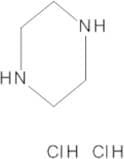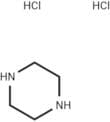
CAS 142-64-3
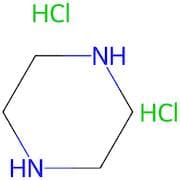
:Piperazine, hydrochloride (1:2)
Description:
Piperazine hydrochloride (1:2) is a chemical compound that consists of piperazine, a cyclic organic compound, and hydrochloric acid in a 1:2 molar ratio. It appears as a white crystalline powder and is highly soluble in water, which makes it useful in various applications. Piperazine itself is a heterocyclic amine with two nitrogen atoms in its six-membered ring structure, contributing to its basic properties. The hydrochloride form enhances its stability and solubility, making it suitable for pharmaceutical formulations. Piperazine and its derivatives are known for their use as anthelmintics, particularly in veterinary medicine, and have applications in treating certain human conditions, such as anxiety and depression. Additionally, piperazine hydrochloride can serve as a building block in organic synthesis and is utilized in the production of various chemical compounds. Safety data indicates that it should be handled with care, as it may cause irritation upon contact with skin or eyes. Proper storage conditions are essential to maintain its integrity and efficacy.
Formula:C4H10N2·2ClH
InChI:InChI=1S/C4H10N2.2ClH/c1-2-6-4-3-5-1;;/h5-6H,1-4H2;2*1H
InChI key:InChIKey=CVVIJWRCGSYCMB-UHFFFAOYSA-N
SMILES:C1CNCCN1.Cl
Synonyms:- Ascarex D
- Diethylenediamine dihydrochloride
- Dihydro Pip Wormer
- Dowzene DHC
- Piperazine Di Hcl
- Piperazine Hydrochloride (1:1)
- Piperazine hydrochloride
- Piperazine wormer premix
- Piperazine, hydrochloride (1:2)
- Piperazine-2,2,3,3,5,5,6,6-D8
- Piperazinium dichloride
- See more synonyms
Sort by
Purity (%)
0
100
|
0
|
50
|
90
|
95
|
100
Found 9 products.
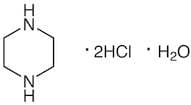
Piperazine Dihydrochloride Monohydrate
CAS:Formula:C4H10N2·2HCl·H2OPurity:>98.0%(N)Color and Shape:White to Almost white powder to crystalMolecular weight:177.07Piperazine Dihydrochloride
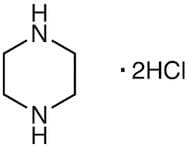
CAS:Formula:C4H10N2·2HClPurity:>98.0%(T)(N)Color and Shape:White to Almost white powder to crystalMolecular weight:159.05Piperazine dihydrochloride
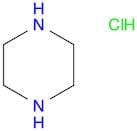
CAS:Formula:C4H12Cl2N2Purity:98%Color and Shape:SolidMolecular weight:159.0575Piperazine Dihydrochloride
CAS:Controlled ProductApplications Piperazine Dihydrochloride is an anthelmintic agent used in the treatment of parasitic worms in animals.
References Boes, J.et al.: Vet. Parasitol., 75, 181 (1998); Praslicka, J. et al.: Int. J. Parasitol., 27, 1523 (1997);Formula:C4H10N2·2ClHColor and Shape:NeatMolecular weight:159.06Piperazine dihydrochloride
CAS:Formula:C4H12Cl2N2Purity:98%Color and Shape:No data available.Molecular weight:159.05Piperazine 2HCl
CAS:Piperazine (2HCl) is gamma-aminobutyric acid (GABA) agonists and its major effects appear to be on the central nervous system. Piperazine was the anthelmintic with the greatest number of reports of toxicoses and suspected toxicoses in cats. Piperazine neurotoxicity in cats and dogs usually was manifested by muscle tremors, ataxia, and/or behavioral disturbances within 24 hours after estimated daily dose(s) between 20 and 110 mg/kg[1]. For di-substituted derivatives, ciprofloxacin was selected and hybrids were synthesized via substitution at piperazinyl-N4. The reaction of piperazinyl-NH of ciprofloxacin with selected drugs resulted in pronounced growth inhibition of standard as well as resistant bacterial strains[2]. The parent piperazine 6 was found to exhibit a reasonable activity toward the HeLa and MDA MB 231 tumor cell lines (IC50= 9.2 and 8.4 μΜ, respectively)[3]. Piperazine adipate (10 mM) causes mortality of A. galli and H. gallinae after a maximum of 30 min exposure, inhibits malate oxidation by 78%, and inhibits aldolase activity in both parasites. Piperazine adipate (10 mM) also inhibits cholinesterase activity by 96% in Ascaridia galli (A. galli) and 93% in Heterakis gallinae (H. gallinae). Piperazine adipate inhibits oxaloacetate reduction by 26% and 55% in A. galli and H. gallinae, resepctively[4].Formula:C4H12Cl2N2Color and Shape:SolidMolecular weight:159.05