CAS 14210-51-6
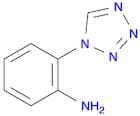
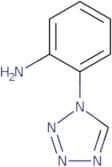
:2-(1H-Tetrazol-1-yl)benzenamine
Description:
2-(1H-Tetrazol-1-yl)benzenamine, with the CAS number 14210-51-6, is an organic compound characterized by the presence of both a tetrazole and an aniline functional group. The tetrazole ring, a five-membered heterocycle containing four nitrogen atoms, imparts notable stability and potential for various chemical reactivity, including nucleophilic substitution and coordination with metal ions. The aniline portion contributes to the compound's basicity and potential for electrophilic aromatic substitution reactions. This compound is typically a solid at room temperature and may exhibit moderate solubility in polar solvents due to the presence of the amino group. Its unique structure allows for applications in pharmaceuticals, agrochemicals, and materials science, particularly in the development of bioactive compounds or as intermediates in synthetic pathways. Additionally, the presence of both aromatic and heterocyclic components may influence its electronic properties, making it a subject of interest in research related to drug design and molecular electronics.
Formula:C7H7N5
InChI:InChI=1S/C7H7N5/c8-6-3-1-2-4-7(6)12-5-9-10-11-12/h1-5H,8H2
InChI key:InChIKey=SZZQSRGQFXNPLZ-UHFFFAOYSA-N
SMILES:NC1=C(N2C=NN=N2)C=CC=C1
Synonyms:- 2-(Tetrazol-1-yl)phenylamine
- 2-(1H-Tetrazol-1-yl)benzenamine
- 2-(1H-Tetraazol-1-yl)aniline
- 1H-Tetrazole, 1-(o-aminophenyl)-
- Benzenamine, 2-(1H-tetrazol-1-yl)-
Sort by
Purity (%)
0
100
|
0
|
50
|
90
|
95
|
100
Found 2 products.
2-(1H-Tetrazol-1-yl)aniline
CAS:2-(1H-Tetrazol-1-yl)aniline is a nitroaniline that has been shown to form complexes with copper. It is an efficient method for the synthesis of 2-(1H-tetrazol-1-yl)anilines from nitrobenzenes, which are orthoformic and can be used as the starting material. 2-(1H-Tetrazol-1-yl)anilines can be used as a reagent in complex formation reactions, such as the nitration of orthoformates, or as a precursor to synthesize other compounds. The biological activity of 2-(1H-tetrazol-1-yl)aniline has been demonstrated by its ability to inhibit cyclocondensation and catalyze the hydrolysis of basic compounds. This compound also shows high efficiency in catalytic reactions with copper salts, which makes it reusable.Formula:C7H7N5Purity:Min. 95%Molecular weight:161.16 g/mol