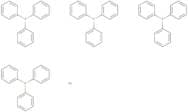
CAS 14221-02-4
:Tetrakis(triphenylphosphine)platinum
Description:
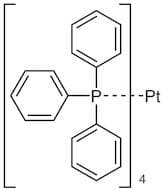
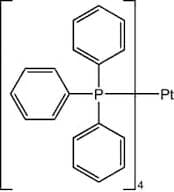
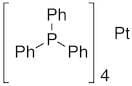
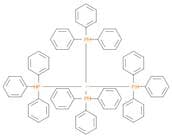
Tetrakis(triphenylphosphine)platinum, with the CAS number 14221-02-4, is a coordination compound featuring platinum as the central metal atom coordinated to four triphenylphosphine ligands. This complex is typically characterized by its square planar geometry, which is common for platinum(II) complexes. The presence of the bulky triphenylphosphine ligands imparts significant steric hindrance, influencing the compound's reactivity and stability. Tetrakis(triphenylphosphine)platinum is often used in various applications, including catalysis, organic synthesis, and as a precursor in the preparation of other platinum complexes. It exhibits notable solubility in organic solvents, making it suitable for reactions in non-aqueous environments. Additionally, the compound can display interesting electronic properties due to the interactions between the platinum center and the phosphine ligands, which can affect its behavior in catalytic processes. Overall, tetrakis(triphenylphosphine)platinum is an important compound in coordination chemistry and organometallic chemistry, with diverse applications in research and industry.
Formula:C72H60P4Pt
InChI:InChI=1S/4C18H15P.Pt/c4*1-4-10-16(11-5-1)19(17-12-6-2-7-13-17)18-14-8-3-9-15-18;/h4*1-15H;
InChI key:InChIKey=SYKXNRFLNZUGAJ-UHFFFAOYSA-N
SMILES:[Pt]([P](C1=CC=CC=C1)(C2=CC=CC=C2)C3=CC=CC=C3)([P](C4=CC=CC=C4)(C5=CC=CC=C5)C6=CC=CC=C6)([P](C7=CC=CC=C7)(C8=CC=CC=C8)C9=CC=CC=C9)[P](C%10=CC=CC=C%10)(C%11=CC=CC=C%11)C%12=CC=CC=C%12
Synonyms:- (T-4)-Tetrakis(triphenylphosphine)platinum
- Platinum tetra(triphenylphosphine)
- Platinum, tetrakis(triphenylphosphine)-
- Platinum, tetrakis(triphenylphosphine)-, (T-4)-
- Platinum-Triphenylphosphane (1:4)
- Tetrakis(triphenylphosphine)platinum
Sort by
Purity (%)
0
100
|
0
|
50
|
90
|
95
|
100
Found 7 products.
Tetrakis(triphenylphosphine)platinum(0)
CAS:Formula:C72H60P4PtColor and Shape:Light yellow to Brown powder to crystalMolecular weight:1,244.25Tetrakis(triphenylphosphine)platinum(0), Pt 15.2% min
CAS:Hydrosilation and oxidationFormula:C72H60P4PtMolecular weight:1244.25Tetrakis(triphenylphosphine)platinum(0), 98%
CAS:Tetrakis(triphenylphosphine)platinum(0), 98%
Formula:Pt(C6H5)3PPurity:98%Color and Shape:yellow xtl.Molecular weight:1244.21Platinum, tetrakis(triphenylphosphine)-, (T-4)-
CAS:Formula:C72H60P4PtPurity:98%Color and Shape:SolidMolecular weight:1244.2198Tetrakis(triphenylphosphine)platinum
CAS:Tetrakis(triphenylphosphine)platinum
Purity:98%Molecular weight:1244.22g/molTetrakis(triphenylphosphine)platinum(0)
CAS:Tetrakis(triphenylphosphine)platinum(0) is a compound that belongs to the group of organometallic complexes. It is a multinuclear compound, which means it contains more than one metal atom. Tetrakis(triphenylphosphine)platinum(0) has been used as an oxidizing agent in organic chemistry and as a catalyst for chemical reactions. Tetrakis(triphenylphosphine)platinum(0) is chemically stable and insoluble in water, making it useful for reactions that require protection from water or other protic solvents. Tetrakis(triphenylphosphine)platinum(0) has been shown to react with chloride to form chloroplatinates, with ester compounds to form platinum esters, and with carbon-carbon double bonds to form platinum carbonyls.Formula:C72H60P4PtColor and Shape:PowderMolecular weight:1,244.23 g/molTetrakis(Triphenylphosphine)platinum(0)
CAS:Formula:C72H60P4PtPurity:95%Color and Shape:Solid, PowderMolecular weight:1244.251