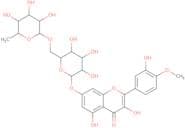
![7-[[6-O-(6-Deoxy-α-L-mannopyranosyl)-β-D-glucopyranosyl]oxy]-3,5-dihydroxy-2-(3-hydroxy-4-methoxyp…](/_next/image/?url=https%3A%2Fstatic.cymitquimica.com%2Fcas-image%2Fthumb-webp%2F399963-7-6-o-6-deoxy-alpha-l-mannopyranosyl-beta-d-glucopyranosyl-oxy-35-dihydroxy-2-3-hydroxy-4-methoxyphenyl-4h-benzopyran-4-one.webp&w=3840&q=75)
CAS 14265-53-3
:7-[[6-O-(6-Deoxy-α-L-mannopyranosyl)-β-D-glucopyranosyl]oxy]-3,5-dihydroxy-2-(3-hydroxy-4-methoxyphenyl)-4H-1-benzopyran-4-one
Description:
The chemical substance known as "7-[[6-O-(6-Deoxy-α-L-mannopyranosyl)-β-D-glucopyranosyl]oxy]-3,5-dihydroxy-2-(3-hydroxy-4-methoxyphenyl)-4H-1-benzopyran-4-one," with the CAS number 14265-53-3, is a flavonoid glycoside. This compound features a complex structure characterized by a benzopyran backbone, which is typical of flavonoids, and is substituted with multiple hydroxyl groups that contribute to its potential antioxidant properties. The presence of sugar moieties, specifically a 6-deoxy-α-L-mannopyranosyl and a β-D-glucopyranosyl unit, indicates that it is a glycoside, which may enhance its solubility and bioavailability. The methoxy and hydroxy groups on the phenyl ring suggest that it may exhibit various biological activities, including anti-inflammatory and antimicrobial effects. Such compounds are often studied for their potential health benefits and applications in pharmaceuticals and nutraceuticals. Overall, this substance exemplifies the structural diversity and functional potential of flavonoid derivatives in natural products chemistry.
Formula:C28H32O16
InChI:InChI=1/C28H32O16/c1-9-18(31)21(34)24(37)27(41-9)40-8-16-19(32)22(35)25(38)28(44-16)42-11-6-13(30)17-15(7-11)43-26(23(36)20(17)33)10-3-4-14(39-2)12(29)5-10/h3-7,9,16,18-19,21-22,24-25,27-32,34-38H,8H2,1-2H3
InChI key:InChIKey=FMZXFFXOKZSIMV-NNFRCGBISA-N
SMILES:O=C1C=2C(OC(=C1O)C3=CC(O)=C(OC)C=C3)=CC(O[C@@H]4O[C@H](CO[C@H]5[C@H](O)[C@H](O)[C@@H](O)[C@H](C)O5)[C@@H](O)[C@H](O)[C@H]4O)=CC2O
Synonyms:- 3,5-dihydroxy-2-(3-hydroxy-4-methoxyphenyl)-4-oxo-4H-chromen-7-yl 6-O-(6-deoxyhexopyranosyl)hexopyranoside
- 4H-1-Benzopyran-4-one, 7-((6-O-(6-deoxy-.alpha.-L-mannopyranosyl)-.beta.-D-glucopyranosyl)oxy)-3,5-dihydroxy-2-(3-hydroxy-4-methoxyphenyl)-
- 4H-1-Benzopyran-4-one, 7-[[6-O-(6-deoxy-α-<span class="text-smallcaps">L</smallcap>-mannopyranosyl)-β-<smallcap>D</span>-glucopyranosyl]oxy]-3,5-dihydroxy-2-(3-hydroxy-4-methoxyphenyl)-
- 7-((6-O-(6-Deoxy-alpha-L-mannopyranosyl)-beta-D-glucopyranosyl)oxy)-3,5-dihydroxy-2-(3-hydroxy-4-methoxyphenyl)-4H-benzopyran-4-one
- 7-[[6-O-(6-Deoxy-α-<span class="text-smallcaps">L</smallcap>-mannopyranosyl)-β-<smallcap>D</span>-glucopyranosyl]oxy]-3,5-dihydroxy-2-(3-hydroxy-4-methoxyphenyl)-4H-1-benzopyran-4-one
- Flavone, 3,3′,5,7-tetrahydroxy-4′-methoxy-, 7-[6-O-(6-deoxy-α-<span class="text-smallcaps">L</smallcap>-mannopyranosyl)-β-<smallcap>D</span>-glucopyranoside]
- Glucopyranoside, 3,5-dihydroxy-2-(3-hydroxy-4-methoxyphenyl)-4-oxo-4H-1-benzopyran-7-yl 6-O-(6-deoxy-alpha-L-mannopyranosyl)-, beta-D-
- Glucopyranoside, 3,5-dihydroxy-2-(3-hydroxy-4-methoxyphenyl)-4-oxo-4H-1-benzopyran-7-yl 6-O-(6-deoxy-α-<span class="text-smallcaps">L</smallcap>-mannopyranosyl)-, β-<smallcap>D</span>-
- Glucopyranoside, tamarixetin-7 6-O-(6-deoxy-α-<span class="text-smallcaps">L</smallcap>-mannopyranosyl)-, β-<smallcap>D</span>-
- Tamarixetin 7-beta-rutinoside
- Tamarixetin 7-rutinoside
- Tamarixetin 7-β-rutinoside
- 7-[[6-O-(6-Deoxy-α-L-mannopyranosyl)-β-D-glucopyranosyl]oxy]-3,5-dihydroxy-2-(3-hydroxy-4-methoxyphenyl)-4H-1-benzopyran-4-one
- Flavone, 3,3′,5,7-tetrahydroxy-4′-methoxy-, 7-[6-O-(6-deoxy-α-L-mannopyranosyl)-β-D-glucopyranoside]
- Glucopyranoside, 3,5-dihydroxy-2-(3-hydroxy-4-methoxyphenyl)-4-oxo-4H-1-benzopyran-7-yl 6-O-(6-deoxy-α-L-mannopyranosyl)-, β-D-
- Glucopyranoside, tamarixetin-7 6-O-(6-deoxy-α-L-mannopyranosyl)-, β-D-
- 4H-1-Benzopyran-4-one, 7-[[6-O-(6-deoxy-α-L-mannopyranosyl)-β-D-glucopyranosyl]oxy]-3,5-dihydroxy-2-(3-hydroxy-4-methoxyphenyl)-
- 3,5-dihydroxy-2-(3-hydroxy-4-methoxyphenyl)-7-[3,4,5-trihydroxy-6-[(3,4,5-trihydroxy-6-methyloxan-2-yl)oxymethyl]oxan-2-yl]oxychromen-4-one
- See more synonyms
Sort by
Purity (%)
0
100
|
0
|
50
|
90
|
95
|
100
Found 1 products.
Tamarixetin-7-O-rutinoside
CAS:Tamarixetin-7-O-rutinoside is a flavonoid glycoside, which is a natural compound derived from the Tamarix plant. In nature, it is typically isolated from species within this genus, known for its phytoactive compounds. Tamarixetin-7-O-rutinoside acts primarily through its antioxidant mechanism, which involves scavenging free radicals and reducing oxidative stress within biological systems. This activity is crucial in minimizing cellular damage and maintaining homeostasis.Formula:C28H32O16Purity:Min. 95%Color and Shape:PowderMolecular weight:624.54 g/mol