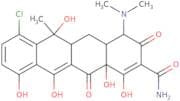
![(1R,4aS,11S,11aS,12aS)-3-[amino(hydroxy)methylidene]-10-chloro-4a,6,7,11-tetrahydroxy-N,N,11-trime…](/_next/image/?url=https%3A%2Fstatic.cymitquimica.com%2Fcas-image%2Fthumb-webp%2F252070-1r-4as-11s-11as-12as-3-amino-hydroxy-methylidene-10-chloro-4a-6711-tetrahydroxy-n-n-11-trimethyl-245-trioxo-12344a-51111a-1212a-decahydrotetracen-1-aminium.webp&w=3840&q=75)
CAS 14297-93-9
:(1R,4aS,11S,11aS,12aS)-3-[amino(hydroxy)methylidene]-10-chloro-4a,6,7,11-tetrahydroxy-N,N,11-trimethyl-2,4,5-trioxo-1,2,3,4,4a,5,11,11a,12,12a-decahydrotetracen-1-aminium
Description:
The chemical substance with the name "(1R,4aS,11S,11aS,12aS)-3-[amino(hydroxy)methylidene]-10-chloro-4a,6,7,11-tetrahydroxy-N,N,11-trimethyl-2,4,5-trioxo-1,2,3,4,4a,5,11,11a,12,12a-decahydrotetracen-1-aminium" and CAS number "14297-93-9" is a complex organic compound characterized by its intricate polycyclic structure and multiple functional groups. It features a tetracyclic framework with several hydroxyl (-OH) groups, which contribute to its potential solubility in polar solvents and may influence its biological activity. The presence of a chloro substituent indicates possible reactivity and interaction with other chemical species. The amino(hydroxy)methylidene group suggests potential for hydrogen bonding and reactivity, which could be significant in biological systems. Additionally, the trimethylammonium moiety implies that the compound may exhibit cationic properties, potentially enhancing its interaction with negatively charged biological membranes or macromolecules. Overall, this compound's unique structural features may confer specific pharmacological or biochemical properties, making it of interest in medicinal chemistry or related fields.
Formula:C22H24ClN2O8
InChI:InChI=1/C22H23ClN2O8/c1-21(32)7-6-8-15(25(2)3)17(28)13(20(24)31)19(30)22(8,33)18(29)11(7)16(27)12-10(26)5-4-9(23)14(12)21/h4-5,7-8,15,26-27,31-33H,6,24H2,1-3H3/p+1/t7-,8-,15+,21-,22-/m0/s1
Sort by
Purity (%)
0
100
|
0
|
50
|
90
|
95
|
100
Found 1 products.
4-Epichlortetracycline
CAS:4-Epichlortetracycline is a metabolite of chlortetracycline, which is derived from the Streptomyces genus of bacteria. It is structurally related to tetracycline antibiotics but differs specifically in its epimerization at the fourth position. This alteration results in a product with significantly reduced antibacterial activity compared to its parent compound. The mechanism of action primarily involves ribosomal binding, inhibiting protein synthesis in susceptible bacteria; however, the epimerization here compromises this efficacy.
Formula:C22H23ClN2O8Purity:Min. 95%Molecular weight:478.9 g/mol