CAS 143-19-1
:9-Octadecenoic acid (9Z)-, sodium salt
Description:
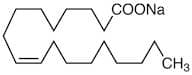
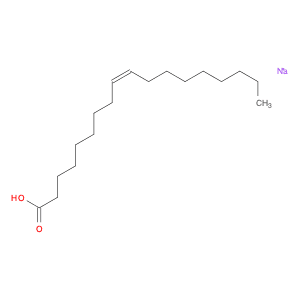
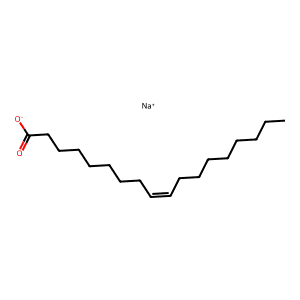
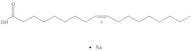
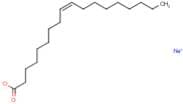
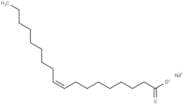
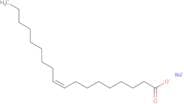
9-Octadecenoic acid (9Z)-, commonly known as oleic acid sodium salt, is a fatty acid salt derived from oleic acid, which is a monounsaturated fatty acid. This compound typically appears as a white to off-white powder or solid and is soluble in water due to the presence of the sodium ion, which enhances its hydrophilicity. It is characterized by its long hydrocarbon chain, consisting of 18 carbon atoms with a double bond at the ninth carbon from the carboxyl end, giving it a cis configuration. This structure contributes to its properties as a surfactant and emulsifier, making it useful in various applications, including food, cosmetics, and pharmaceuticals. Additionally, oleic acid is known for its potential health benefits, such as promoting heart health and reducing inflammation. The sodium salt form enhances its stability and usability in formulations. Overall, 9-Octadecenoic acid (9Z)-, sodium salt is valued for its functional properties and versatility in multiple industries.
Formula:C18H33NaO2
InChI:InChI=1/C18H34O2.Na/c1-2-3-4-5-6-7-8-9-10-11-12-13-14-15-16-17-18(19)20;/h9-10H,2-8,11-17H2,1H3,(H,19,20);/q;+1/p-1/b10-9+;
InChI key:InChIKey=ZQCUDFIHJAXGTP-KVVVOXFISA-N
SMILES:C(C/C=C\CCCCCCCC)CCCCCC(O)=O.[Na]
Synonyms:- (Z)-9-Octadecenoic acid sodium salt
- 9-Octadecenoic acid (9Z)-, sodium salt (1:1)
- 9-Octadecenoic acid (Z)-, sodium salt
- 9-Octadecenoic acid, sodium salt, (Z)-
- Edenor OL 72MY, sodium salt
- Eunatrol
- Ligaphob NT 90
- Lunac MY 98
- Lunac SO 90L
- NPS Red Oil Soap
- Natriumoleat
- Nonsoul ON 1
- Nonsoul ON-A
- Olate Flakes
- Oleate de sodium
- Oleate, Sodium
- Oleato De Sodio
- Oleic acid, sodium salt
- Pionin A 5
- Pionin D 951P
- Sodium Oleate
- 9-Octadecenoic acid (9Z)-, sodium salt
- sodium (9E)-octadec-9-enoate
- sodium (9Z)-octadec-9-enoate
- Osteum
- Sodium 9-octadecenoate
- 9-Octadecenoic acid, sodium salt
- (9Z)-octadec-9-enoic acid
- cis-9-Octadecenoic acid sodium salt, Oleic acid sodium salt
- OLEIC ACID SODIUM
- OLEIC ACID SODIUM 95%
- LSURE, NATRIUM-SALZ
- olateflakes
- 9-Octadecanoic acid, sodium salt
- Oleic acid, sodium salt, 65-90% oleic C18
- CIS-9-OCTADECENOIC ACID SODIUM SALT
- SODIUM OLEATE POWDER
- SODIUM (Z)-9-OCTADECENOATE
- SodiumOleatePure
- 9-Octadecenoicacid(Z)-,sodiumsalt
- See more synonyms
Sort by
Purity (%)
0
100
|
0
|
50
|
90
|
95
|
100
Found 12 products.
Sodium Oleate
CAS:Formula:C18H33NaO2Purity:>97.0%(T)Color and Shape:White to Light yellow powder to crystalMolecular weight:304.45Sodium oleate, 99%
CAS:Sodium oleate, 99%
Formula:CH3(CH2)7CHCH(CH2)7COONaPurity:99%Color and Shape:white pwdr.Molecular weight:304.44Sodium oleate
CAS:Formula:C18H33NaO2Purity:≥ 95.0% (anhydrous basis)Color and Shape:White to off-white powderMolecular weight:304.44Sodium oleate
CAS:Sodium oleateFormula:C18H33O2·NaPurity:99%Color and Shape: off-white solidMolecular weight:304.44g/molSodium Oleate
CAS:Controlled ProductApplications Sodium oleate (cas# 143-19-1) is a useful research chemical.
Formula:C18H33NaO2Color and Shape:NeatMolecular weight:304.44Sodium oleate
CAS:Sodium oleate (cis-9-Octadecenoic acid sodium salt) (Oleic acid sodium) is an abundant monounsaturated fatty acid sodium.Formula:C18H33NaO2Purity:98.11%Color and Shape:SolidMolecular weight:304.44Sodium oleate
CAS:Sodium oleate is a chemical compound that is part of the soap-making process. It forms when sodium reacts with animal or vegetable oils and fats. Sodium oleate has been shown to be thermally stable, which means that it does not break down at high temperatures. Sodium oleate can be used to measure particle size by using the Langmuir adsorption isotherm technique. The titration calorimetry technique has also been used to study the thermal stability of this compound. Symptoms of overdose include kidney failure and paralysis of the central nervous system. Sodium oleate has been shown to inhibit bacterial growth in culture with a kinetic energy of 75 kJ/mol and an electrochemical impedance spectroscopy (EIS) measurement of 4 MΩ at 10 Hz. This compound also inhibits protein synthesis, leading to cell death by preventing transcription and translation, in experimental models using copper chloride as the catalyst.Formula:C18H33NaO2Purity:Min. 95%Color and Shape:White PowderMolecular weight:304.44 g/mol