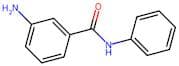
CAS 14315-16-3
:3-Amino-N-phenylbenzamide
Description:
3-Amino-N-phenylbenzamide, with the CAS number 14315-16-3, is an organic compound characterized by the presence of an amino group and a phenyl group attached to a benzamide structure. This compound typically appears as a solid and is soluble in polar organic solvents. Its molecular structure features a benzene ring, which contributes to its aromatic properties, and the amino group (-NH2) enhances its reactivity, making it a potential candidate for various chemical reactions, including nucleophilic substitutions and coupling reactions. The presence of the amide functional group (-C(=O)NH-) indicates that it can participate in hydrogen bonding, influencing its physical properties such as melting and boiling points. 3-Amino-N-phenylbenzamide may also exhibit biological activity, making it of interest in pharmaceutical research. Its synthesis often involves the reaction of an appropriate aniline derivative with benzoyl chloride or a related compound. As with many organic compounds, safety precautions should be taken when handling it, as it may pose health risks if ingested or inhaled.
Formula:C13H12N2O
InChI:InChI=1S/C13H12N2O/c14-11-6-4-5-10(9-11)13(16)15-12-7-2-1-3-8-12/h1-9H,14H2,(H,15,16)
InChI key:InChIKey=KPSPULPPMWHXGE-UHFFFAOYSA-N
SMILES:C(NC1=CC=CC=C1)(=O)C2=CC(N)=CC=C2
Synonyms:- m-Aminobenzanilide
- 3-Aminobenzanilide
- Benzanilide, 3-amino-
- 3-Amino-N-phenylbenzamide
- Benzamide, 3-amino-N-phenyl-
Sort by
Purity (%)
0
100
|
0
|
50
|
90
|
95
|
100
Found 2 products.
3-Aminobenzanilide
CAS:3-Aminobenzanilide is an organic compound that is used as a starting material in the synthesis of other compounds. It is also used in the synthesis of ethylenediamine and benzamide, which are used in the production of rubber. 3-Aminobenzanilide can be synthesized by reacting benzoyl chloride with ammonia or ethylenediamine. The reaction with ammonia produces 3-aminobenzamide, while that with ethylenediamine produces 3-aminobenzene. This compound has been shown to induce pentylenetetrazol convulsions and to produce neurological symptoms when administered at high doses.Formula:C13H12N2OPurity:Min. 95%Color and Shape:White/Off-White SolidMolecular weight:212.25 g/mol