CAS 14346-13-5
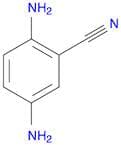
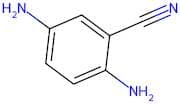
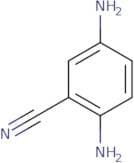
:2,5-Diaminobenzonitrile
Description:
2,5-Diaminobenzonitrile, with the CAS number 14346-13-5, is an organic compound characterized by the presence of two amino groups (-NH2) and a nitrile group (-C≡N) attached to a benzene ring. This compound typically appears as a solid and is soluble in polar solvents due to the presence of the amino groups, which can engage in hydrogen bonding. The amino groups contribute to its basicity, making it reactive in various chemical reactions, such as nucleophilic substitutions and coupling reactions. 2,5-Diaminobenzonitrile is often utilized in the synthesis of dyes, pharmaceuticals, and agrochemicals, owing to its functional groups that allow for further chemical modifications. Additionally, it may exhibit biological activity, making it of interest in medicinal chemistry. Safety data should be consulted for handling, as compounds with amino and nitrile functionalities can pose health risks if not managed properly. Overall, 2,5-Diaminobenzonitrile is a versatile compound with significant applications in organic synthesis and materials science.
Formula:C7H7N3
InChI:InChI=1/C7H7N3/c8-4-5-3-6(9)1-2-7(5)10/h1-3H,9-10H2
SMILES:c1cc(c(cc1N)C#N)N
Synonyms:- 5-Aminoanthranilonitrile
- 2-Cyano-1,4-phenylenediamine
- 2,5-diamino Benzonitrile
Sort by
Purity (%)
0
100
|
0
|
50
|
90
|
95
|
100
Found 4 products.
2,5-Diaminobenzonitrile
CAS:2,5-Diaminobenzonitrile is a chemical compound with the molecular formula C6H5N3. It is a white crystalline solid that is insoluble in water and soluble in organic solvents such as acetone, chloroform, and ether. 2,5-Diaminobenzonitrile has been shown to be an effective monomer for polymer synthesis due to its stability and high densities. This chemical also has the ability to undergo hydrogen bonding and form hydrogen peroxide when heated to a temperature of 100 °C. The thermal isomerization of 2,5-diaminobenzonitrile can be slowed by adding other amines or nitrites.Formula:C7H7N3Purity:Min. 95%Color and Shape:PowderMolecular weight:133.15 g/mol