![6-BROMO-1H-PYRROLO[2,3-B]PYRIDINE](/_next/image/?url=https%3A%2Fstatic.cymitquimica.com%2Fcas-image%2Fthumb-webp%2F281795-6-bromo-1h-pyrrolo-23-b-pyridine.webp&w=3840&q=75)
CAS 143468-13-7
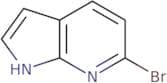
:6-BROMO-1H-PYRROLO[2,3-B]PYRIDINE
Description:
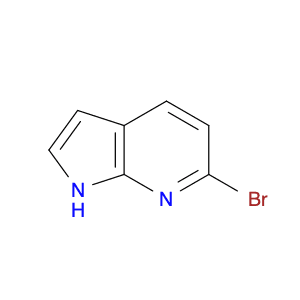
6-Bromo-1H-pyrrolo[2,3-b]pyridine is a heterocyclic organic compound characterized by its fused pyrrole and pyridine rings, with a bromine substituent at the 6-position. This compound typically exhibits a pale yellow to brown solid appearance and is soluble in organic solvents such as dimethyl sulfoxide (DMSO) and dichloromethane. It has potential applications in medicinal chemistry, particularly in the development of pharmaceuticals due to its structural similarity to biologically active compounds. The presence of the bromine atom can enhance its reactivity and influence its interaction with biological targets. Additionally, 6-bromo-1H-pyrrolo[2,3-b]pyridine may exhibit interesting electronic properties due to the conjugated system formed by the fused rings, which can affect its optical characteristics. As with many heterocycles, it may also participate in various chemical reactions, including nucleophilic substitutions and coupling reactions, making it a valuable intermediate in organic synthesis. Safety and handling precautions should be observed, as with all chemical substances, due to potential toxicity and reactivity.
Formula:C7H5BrN2
InChI:InChI=1/C7H5BrN2/c8-6-2-1-5-3-4-9-7(5)10-6/h1-4H,(H,9,10)
SMILES:c1cc(Br)nc2c1cc[nH]2
Synonyms:- 6-Bromo-7-Azaindole
- 1H-Pyrrolo[2,3-b]pyridine, 6-bromo-
- 2-Aminobenzene-1,3-Diol
- 6-Bromo-7-azaindole,96%
- 6-broMo-
- 6-broMo-1H-pyrrolo[2
- 6-BROMO-1H-PYRROLO[2,3-B]PYRIDINE
Sort by
Purity (%)
0
100
|
0
|
50
|
90
|
95
|
100
Found 4 products.
Ref: IN-DA0034BY
1g43.00€5g109.00€10g171.00€25g297.00€50g675.00€100gTo inquire250gTo inquire250mg27.00€500mg36.00€6-Bromo-1H-pyrrolo[2,3-b]pyridine
CAS:6-Bromo-1H-pyrrolo[2,3-b]pyridinePurity:97%Molecular weight:197.03g/mol6-Bromo-7-azaindole
CAS:6-Bromo-7-azaindole is a homologous molecule. It is an electron deficient compound with a piperidine moiety at the 6 position and a nitrogen atom at the 7 position. The nitrogen atom substitutes for an oxygen atom, making this molecule reactive. The electron deficient nature of this molecule makes it suitable for use in transistors and other physicochemical devices. 6-Bromo-7-azaindole has been shown to be effective against carcinoma cells in vitro, as well as to inhibit tumor growth in vivo. This drug also causes homologous recombination by interacting with DNA in mammalian cells. 6-Bromo-7-azaindole binds to DNA, forming a covalent bond with the guanine base of DNA through the nitrogen atom, which is electron deficient.
Formula:C7H5BrN2Purity:Min. 95%Color and Shape:Off-White To Beige To Yellow SolidMolecular weight:197.03 g/mol

![6-Bromo-1H-pyrrolo[2,3-b]pyridine](/_next/image/?url=https%3A%2Fstatic.cymitquimica.com%2Fproducts%2F54%2Fthumb%2FOR321485.jpg&w=3840&q=75)