![4,9-Dihydroxy-7H-furo[3,2-g][1]benzopyran-7-one](/_next/image/?url=https%3A%2Fstatic.cymitquimica.com%2Fcas-image%2Fthumb-webp%2F256511-58-dihydroxypsoralen.webp&w=3840&q=75)
CAS 14348-23-3
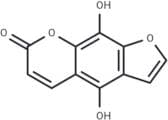
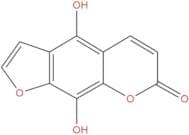
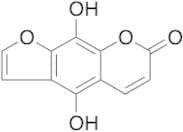
:4,9-Dihydroxy-7H-furo[3,2-g][1]benzopyran-7-one
Description:
4,9-Dihydroxy-7H-furo[3,2-g][1]benzopyran-7-one, with the CAS number 14348-23-3, is a chemical compound that belongs to the class of flavonoids, specifically a type of chromone. This substance features a fused ring system that includes a furan and a benzopyran moiety, contributing to its unique structural characteristics. The presence of hydroxyl groups at the 4 and 9 positions enhances its potential for hydrogen bonding and may influence its solubility and reactivity. This compound is known for its antioxidant properties, which can be attributed to the presence of the phenolic hydroxyl groups. Additionally, it may exhibit various biological activities, including anti-inflammatory and antimicrobial effects, making it of interest in pharmacological research. The compound's stability and reactivity can be influenced by environmental factors such as pH and temperature. Overall, 4,9-Dihydroxy-7H-furo[3,2-g][1]benzopyran-7-one is a noteworthy compound in the study of natural products and their potential applications in medicine and biochemistry.
Formula:C11H6O5
InChI:InChI=1/C11H6O5/c12-7-2-1-5-8(13)6-3-4-15-10(6)9(14)11(5)16-7/h1-4,13-14H
InChI key:InChIKey=DZEPISXWRUMGFN-UHFFFAOYSA-N
SMILES:OC=1C2=C(C(O)=C3C1OC=C3)C=CC(=O)O2
Synonyms:- 4,9-Dihydroxy-7H-furo[3,2-g][1]benzopyran-7-one
- 5,8-Dihydroxypsoralen
- 7H-Furo(3,2-g)(1)benzopyran-7-one, 4,9-dihydroxy-
- Psoralen, 5,8-dihydroxy-
Sort by
Purity (%)
0
100
|
0
|
50
|
90
|
95
|
100
Found 4 products.
5,8-Dihydroxypsoralen
CAS:5,8-Dihydroxypsoralen is a natural product from Pueraria lobata (Willd.) OhwiFormula:C11H6O5Purity:98%Color and Shape:SolidMolecular weight:218.165,8-Dihydroxypsoralen
CAS:Controlled ProductFormula:C11H6O5Color and Shape:NeatMolecular weight:218.1625,8-Dihydroxypsoralen
CAS:5,8-Dihydroxypsoralen is a naturally occurring furanocoumarin compound, which is a secondary metabolite sourced from various plant species, such as those within the genera *Ammi* and *Citrus*. Its mode of action involves intercalating into DNA and forming covalent bonds upon exposure to ultraviolet A (UVA) light. This interaction results in DNA cross-linking, which inhibits DNA synthesis and cellular proliferation.Formula:C11H6O5Purity:Min. 95%Molecular weight:218.16 g/mol