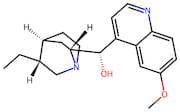
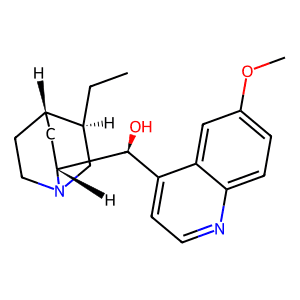
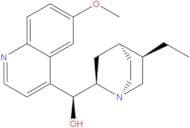
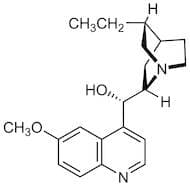
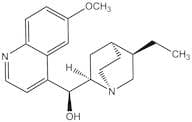
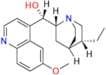
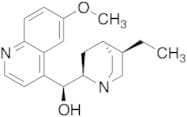
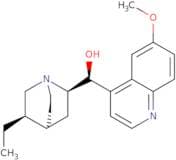
CAS 1435-55-8
:Hydroquinidine
Description:
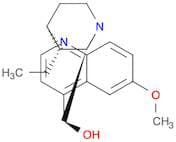
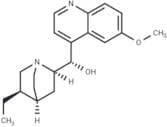
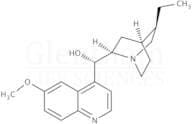
Hydroquinidine is a chemical compound that belongs to the class of quinidine derivatives, primarily known for its use in the treatment of certain cardiac arrhythmias. It is an alkaloid that exhibits antiarrhythmic properties, functioning as a sodium channel blocker, which helps to stabilize the cardiac membrane and restore normal heart rhythm. Hydroquinidine is typically found in a crystalline form and is characterized by its specific molecular structure, which includes a bicyclic system. The compound is soluble in water and exhibits moderate lipophilicity, allowing it to interact effectively with biological membranes. Its pharmacological profile includes potential side effects such as gastrointestinal disturbances and cardiovascular effects, necessitating careful monitoring during therapeutic use. Hydroquinidine is often administered in a controlled clinical setting, and its efficacy and safety are evaluated through rigorous clinical trials. As with many pharmaceuticals, it is essential to consider drug interactions and contraindications when prescribing hydroquinidine to patients.
Formula:C20H26N2O2
InChI:InChI=1S/C20H26N2O2/c1-3-13-12-22-9-7-14(13)10-19(22)20(23)16-6-8-21-18-5-4-15(24-2)11-17(16)18/h4-6,8,11,13-14,19-20,23H,3,7,9-10,12H2,1-2H3/t13-,14-,19+,20-/m0/s1
InChI key:InChIKey=LJOQGZACKSYWCH-LHHVKLHASA-N
SMILES:[C@H](O)(C=1C2=C(C=CC(OC)=C2)N=CC1)[C@@]3([N@@]4C[C@H](CC)[C@](C3)(CC4)[H])[H]
Synonyms:- (4beta,9R)-6'-methoxy-10,11-dihydrocinchonan-9-ol
- (8xi,9S)-6'-methoxy-10,11-dihydrocinchonan-9-ol
- (9S)-10,11-Dihydro-6′-methoxycinchonan-9-ol
- (9S)-6'-methoxy-10,11-dihydrocinchonan-9-ol
- 10,11-Dihydroquinidine
- 6'-Methoxy-10,11-Dihydrocinchonan-9-Ol
- Cinchonan-9-ol, 10,11-dihydro-6′-methoxy-, (9S)-
- Dhqd
- Dihydroquinidine
- Hydroconquinine
- Hydroquinidine
Sort by
Purity (%)
0
100
|
0
|
50
|
90
|
95
|
100
Found 14 products.
Hydroquinidine
CAS:Hydroquinidine ((+)-Hydroquinidine) is an organic compound, used as an antiarrhythmic agent.Formula:C20H26N2O2Purity:98.61% - 99.68%Color and Shape:SolidMolecular weight:326.43Hydroquinidine
CAS:Formula:C20H26N2O2Purity:>98.0%(T)(HPLC)Color and Shape:White to Light yellow powder to crystalMolecular weight:326.44(+)-dihydroquinidine
CAS:Cinchona alkaloidFormula:C20H26N2O2Purity:≥ 95.0 % (HPLC)Color and Shape:PowderMolecular weight:326.44(1S)-((2R,4S,5R)-5-Ethylquinuclidin-2-yl)(6-methoxyquinolin-4-yl)methanol
CAS:Formula:C20H26N2O2Purity:97%Color and Shape:SolidMolecular weight:326.44(+)-Dihydroquinidine
CAS:Controlled ProductApplications (+)-Dihydroquinidine (cas# 1435-55-8) is a useful research chemical.
Formula:C20H26N2O2Color and Shape:NeatMolecular weight:326.43Dihydroquinidine
CAS:Dihydroquinidine is a mannuronic acid that is used in the treatment of autoimmune diseases such as atrial fibrillation. It has been shown to be effective against sublethal doses of papillary muscle and cardiac effects due to its ability to inhibit the production of reactive oxygen species. Dihydroquinidine binds to human serum albumin, which prevents it from crossing the blood-brain barrier. This drug has also been shown to have significant colloidal gold binding properties and may be useful in the treatment of Alzheimer's disease due to its ability to inhibit quinolinic acid production. Dihydroquinidine does not appear to have any significant toxicity in humans, but it should not be used with other drugs that are known to cause torsades de pointes or ventricular arrhythmias.Formula:C20H26N2O2Purity:Min. 95%Molecular weight:326.43 g/mol