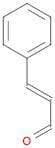
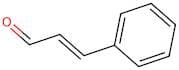
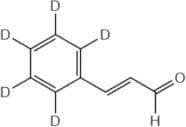
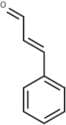
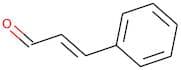
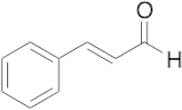
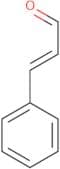
CAS 14371-10-9
:cinnamaldehyde
Description:
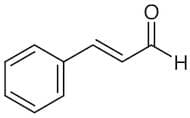
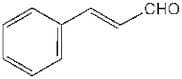
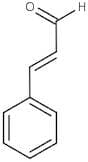
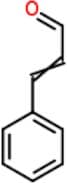
Cinnamaldehyde, with the CAS number 14371-10-9, is an organic compound that serves as the primary component of cinnamon oil, contributing to its characteristic flavor and aroma. It is classified as an aldehyde, specifically a phenylpropanoid, and has the molecular formula C9H8O. Cinnamaldehyde is a colorless to pale yellow liquid at room temperature, exhibiting a sweet, spicy scent reminiscent of cinnamon. It is soluble in organic solvents such as ethanol and ether but has limited solubility in water. The compound is known for its antimicrobial and antifungal properties, making it useful in food preservation and as a natural flavoring agent. Additionally, cinnamaldehyde has been studied for its potential health benefits, including anti-inflammatory and antioxidant effects. However, it can be irritating to the skin and mucous membranes, necessitating caution during handling. Overall, cinnamaldehyde is a versatile compound with applications in food, cosmetics, and pharmaceuticals, reflecting its significance in both industry and research.
Formula:C9H8O
InChI:InChI=1/C9H8O/c10-8-4-7-9-5-2-1-3-6-9/h1-8H/b7-4-
InChI key:InChIKey=KJPRLNWUNMBNBZ-QPJJXVBHSA-N
SMILES:C(=C/C=O)\C1=CC=CC=C1
Synonyms:- (2E)-3-Phenyl-2-propenal
- (2E)-3-phenylprop-2-enal
- (2Z)-3-phenylprop-2-enal
- (E)-3-Phenylacrolein
- (E)-3-Phenylprop-2-en-1-al
- (E)-3-Phenylprop-2-enal
- (E)-3-Phenylprop-2-enone
- (E)-3-Phenylpropenal
- (E)-Cinnamaldehyde
- 2-Phenylprop-2-Enal
- 2-Propenal, 3-phenyl-, (2E)-
- 2-Propenal, 3-phenyl-, (E)-
- 3-Phenyl-2-propenal
- 3-Phenylprop-2-Enal
- Cinnam Aldehyde
- Cinnamaldehyde, (E)-
- Cinnamic aldehyde
- Cinnamyl Aldehyde
- E-Cinnamyl aldehyde
- Natural Cinnamyl Aldehyde
- Zimtaldehyd
- trans-3-Phenyl-2-propenal
- trans-3-Phenylpropenal
- trans-Benzenepropenal
- trans-Cinnamaldehyde
- trans-Cinnamic aldehyde
- trans-Cinnamylaldehyde
- Synthetic Cinnamaldehyde
- STYRONE
- TRANS-PHENYLACRYLALDEHYDE
- LABOTEST-BB LT00939010
- 3-PHENYLPROPENAL
- TRANS-ALPHA CINNAMALDEHYDE
- (e)-2-propena
- AKOS B004060
- TRANS-3-PHENYL-2-PROPEN-1-AL
- CINNAMALDEHYDE, TRANS-
- AKOS BBS-00003207
- FEMA 2286
- TRANS-PHENYLACROLEIN
- TRANS-CINNAMAL
- See more synonyms
Sort by
Purity (%)
0
100
|
0
|
50
|
90
|
95
|
100
Found 13 products.
trans-Cinnamaldehyde
CAS:Formula:C9H8OPurity:>98.0%(GC)Color and Shape:Colorless to Light orange to Yellow clear liquidMolecular weight:132.16trans-Cinnamaldehyde, 98+%
CAS:trans-Cinnamaldehyde is used in the flavor and perfume industry. It is also used in medicine. It reacts with glutathione to get an adduct 1'-(glutathion-S-yl)-dihydrocinnamaldehyde. It is used to prepare cinnamylidene-bisacetamide by reacting with acetamide. Further, it inhibits xanthine oxidase. ThFormula:C9H8OPurity:98+%Color and Shape:Clear colorless to yellow, LiquidMolecular weight:132.16trans-Cinnamaldehyde
CAS:trans-Cinnamaldehyde analytical standard provided with chromatographic purity, to be used as reference material for qualitative determination.Formula:C9H8OPurity:(GC) ≥95%Color and Shape:LiquidMolecular weight:132.16Cinnamaldehyde
CAS:Cyclic aldehydes without other oxygen function not elsewhere specified or includedFormula:C9H8OColor and Shape:Yellow Light Yellow LiquidMolecular weight:132.057512-Propenal, 3-phenyl-, (2E)-
CAS:Formula:C9H8OPurity:96%Color and Shape:LiquidMolecular weight:132.1592trans-Cinnamaldehyde
CAS:Formula:C9H8OPurity:95%Color and Shape:Liquid, ClearMolecular weight:132.162trans-Cinnamaldehyde
CAS:Trans-Cinnamaldehyde (Phenylacrolein) exhibits anti-inflammatory activities and antidepressant-like effects in stressed mid-aged rats as a COX-2 inhibitor.Formula:C9H8OPurity:98.07%Molecular weight:132.16trans-Cinnamaldehyde
CAS:Applications trans-Cinnamaldehyde is an aromatic aldehyde that is derived from Cinnamomi cortex, the dried bark of the Cinnamomum cassia tree. trans-Cinnamaldehyde is a known cause of allergic contact dermatitis (ACD) in humans and is a major component of cinnamon oil. trans-Cinnamaldehyde also exhibits cytotoxic effects on human leukemia cells.
References Hayashi, K., et al.: Antivir. Res., 74, 1 (2007); He, Z., et al.: J. Agr. Food Chem., 53, 2424 (2005); Peters, M. & Caldwell, J.: Food Chem. Toxicol., 32, 869 (1994); Smith, C., et al.: Toxicol. Appl. Pharm., 168, 189 (2000); Zhang, J., et al.: Acta. Pharm. Sinic., 31, 861 (2010)Formula:C9H8OColor and Shape:NeatMolecular weight:132.16trans-Cinnamaldehyde
CAS:Cinnamaldehyde is a natural compound that has shown to have antiviral and antimicrobial properties. It has been shown to inhibit the toll-like receptor, which is a protein on the surface of cells that detects bacteria and other microorganisms. Cinnamaldehyde is also able to inhibit c. glabrata growth in vitro at concentrations between 10 and 100 μM, as well as copper-mediated cell death in hl-60 cells. Cinnamaldehyde has been shown to cause neuronal death by interfering with cellular physiology. This compound can be used in the treatment of infectious diseases because it inhibits bacterial dna gyrase, dna topoisomerase, and rna synthesis.Formula:C9H8OPurity:Min. 95%Color and Shape:PowderMolecular weight:132.16 g/mol