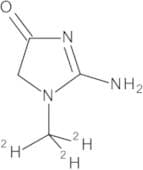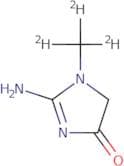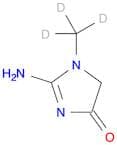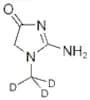
CAS 143827-20-7
:creatinine-methyl-D3
Description:
Creatinine-methyl-D3, with the CAS number 143827-20-7, is a stable isotopic form of creatinine, which is a breakdown product of creatine phosphate in muscle and is typically excreted in urine. This compound is labeled with deuterium (D3), which is a heavier isotope of hydrogen, allowing for its use in various analytical techniques, particularly in metabolic studies and tracer experiments. The incorporation of deuterium enhances the sensitivity and specificity of mass spectrometry analyses, making it valuable in pharmacokinetic studies and biomarker research. Creatinine itself is a non-protein nitrogenous compound, and its levels in blood and urine are commonly used to assess kidney function. The methylation aspect refers to the addition of a methyl group, which can influence the compound's solubility and reactivity. Overall, creatinine-methyl-D3 serves as a useful tool in biochemical research, particularly in understanding metabolic pathways and the dynamics of creatinine in biological systems.
Formula:C4H4D3N3O
InChI:InChI=1/C4H7N3O/c1-7-2-3(8)6-4(7)5/h2H2,1H3,(H2,5,6,8)/i1D3
SMILES:C(N1CC(=NC1=N)O)([2H])([2H])[2H]
Synonyms:- 2-Imino-1-(Trideuteriomethyl)Imidazolidin-4-One
Sort by
Purity (%)
0
100
|
0
|
50
|
90
|
95
|
100
Found 6 products.
Creatinine-D3
CAS:Controlled ProductApplications Labelled Creatinine. The end product of creatine catabolism. Normal constituent of urine. Also found together with creatine in muscle tissues and blood. Occurs in all soils and in grain seeds and other vegetable matter. Has been found in certain fish and in crab meat extract.
References Folin, et al.: J. Biol. Chem., 17, 463 (1914),Formula:C42H3H4N3OColor and Shape:Off-WhiteMolecular weight:116.14Creatinine-d3
CAS:Controlled ProductCreatinine-d3 is a radioactive form of creatinine that can be used to measure the degree of renal function in humans. Creatinine-d3 is a metabolite of creatine, which is synthesized primarily in muscle tissue and excreted by the kidney. Creatinine-d3 uptake reflects the glomerular filtration rate (GFR) and can be used as an indicator of renal disease. The metabolism of creatinine-d3 can be monitored using chromatographic methods, such as HPLC, or mass spectrometry. Due to its low detection limit, creatinine-d3 has been used for validation studies in humans and other mammals. It has also been used for the analysis of urine samples from healthy volunteers and patients with chronic kidney disease. Creatinine-d3 is often normalized to creatinine concentration in human urine samples because it does not react with other metabolites found in urine samples. This allows for accurate measurementsFormula:C4H4D3N3OPurity:Min. 95%Molecular weight:116.13 g/mol4H-Imidazol-4-one, 2-amino-1,5-dihydro-1-(methyl-d3)-
CAS:Formula:C4H4D3N3OPurity:98%Color and Shape:SolidMolecular weight:116.1364Creatinine-D3
CAS:Creatinine-D3 is a deuterium-labeled Creatinine which is a break-down product of creatine phosphate in muscle.Formula:C4H7N3OPurity:98%Color and Shape:SolidMolecular weight:116.14