CAS 14401-75-3
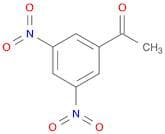
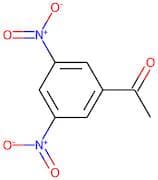
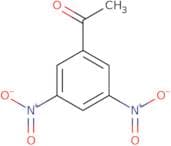
:1-(3,5-Dinitrophenyl)ethanone
Description:
1-(3,5-Dinitrophenyl)ethanone, also known as 3,5-dinitroacetophenone, is an organic compound characterized by the presence of a dinitrophenyl group attached to an ethanone (acetone) moiety. It typically appears as a yellow crystalline solid and is known for its strong electron-withdrawing dinitro substituents, which significantly influence its chemical reactivity and properties. This compound is often used in organic synthesis and as an intermediate in the production of various dyes and pharmaceuticals. Its dinitro groups enhance its electrophilic character, making it a useful reagent in nucleophilic substitution reactions. Additionally, 1-(3,5-Dinitrophenyl)ethanone exhibits notable UV-Vis absorption characteristics due to the presence of the aromatic system, which can be utilized in analytical applications. However, it is important to handle this compound with care, as it may pose health risks, including toxicity and potential environmental hazards. Proper safety protocols should be followed when working with this substance in a laboratory setting.
Formula:C8H6N2O5
InChI:InChI=1S/C8H6N2O5/c1-5(11)6-2-7(9(12)13)4-8(3-6)10(14)15/h2-4H,1H3
InChI key:InChIKey=WGJQPJOLPLYFJH-UHFFFAOYSA-N
SMILES:C(C)(=O)C1=CC(N(=O)=O)=CC(N(=O)=O)=C1
Synonyms:- ,5’
- 1-(3,5-Dinitrophenyl)Ethanone
- 3',5'-Dinitroacetophenone
- 3',5'-Dinitroacetophenone 3,5-Dinitroacetophenone
- 3,5-Dinitroacetophenone
- 3,5-Dinitroacetophfnone
- 3,5-Dinitrophenylmethylketone
- 3’
- Acetophenone, 3′,5′-dinitro-
- Ethanone, 1-(3,5-dinitrophenyl)-
- NSC 87635
Sort by
Purity (%)
0
100
|
0
|
50
|
90
|
95
|
100
Found 4 products.
Ethanone, 1-(3,5-dinitrophenyl)-
CAS:Formula:C8H6N2O5Purity:97%Color and Shape:SolidMolecular weight:210.14363',5'-Dinitroacetophenone
CAS:3',5'-Dinitroacetophenone is a chemical compound that is used as an intermediate in the synthesis of other organic compounds. This chemical is highly toxic and can be fatal if ingested. 3',5'-Dinitroacetophenone has a high solubility in water, but reacts quickly with air, so it should be stored in an airtight container. It has been shown to produce foramen ovale-type lesions when applied to the maxillary sinus. This chemical also has an electron deficient profile and produces frequencies at about 350 MHz and chloride ions at about 250 MHz.Formula:C8H6N2O5Purity:Min. 95%Color and Shape:PowderMolecular weight:210.14 g/mol1-(3,5-dinitrophenyl)ethanone
CAS:Formula:C8H6N2O5Purity:97%Color and Shape:SolidMolecular weight:210.145