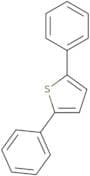
CAS 1445-78-9
:2,5-DIPHENYLTHIOPHENE
Description:
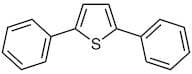
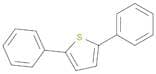
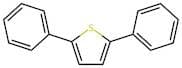
2,5-Diphenylthiophene is an organic compound characterized by its thiophene ring, which is a five-membered aromatic heterocycle containing sulfur. This compound features two phenyl groups attached to the 2 and 5 positions of the thiophene ring, enhancing its stability and electronic properties. It is typically a solid at room temperature and exhibits a yellow to light brown color. 2,5-Diphenylthiophene is known for its semiconducting properties, making it of interest in organic electronics, particularly in organic light-emitting diodes (OLEDs) and organic photovoltaic cells. The presence of the phenyl groups contributes to its π-conjugated system, which is crucial for its electronic behavior. Additionally, this compound is relatively stable under ambient conditions but may undergo reactions typical of thiophenes, such as electrophilic substitution. Its solubility is generally moderate in organic solvents, which is advantageous for various applications in materials science and organic synthesis. Overall, 2,5-diphenylthiophene is a significant compound in the field of organic chemistry and materials science.
Formula:C16H12S
InChI:InChI=1/C16H12S/c1-3-7-13(8-4-1)15-11-12-16(17-15)14-9-5-2-6-10-14/h1-12H
Synonyms:- Thiophene, 2,5-diphenyl-
- 2,5-Diphenylthiophene
Sort by
Purity (%)
0
100
|
0
|
50
|
90
|
95
|
100
Found 5 products.
2,5-Diphenylthiophene
CAS:Formula:C16H12SPurity:>98.0%(GC)Color and Shape:White to Almost white powder to crystalMolecular weight:236.332,5-Diphenylthiophene
CAS:2,5-Diphenylthiophene is a fluorescent dye that has been used to study the transport properties of aromatic molecules. This compound is characterized by two phenyl groups and a thiophene ring with a sulfur atom in the 2 position. The red shift observed for this compound is due to the electron withdrawing effect of the sulfur atom. 2,5-Diphenylthiophene has shown inhibition activity against Nepeta cataria, which may be due to its ability to form sulfoxide bonds with proteins. It has also been found that this molecule can polymerize and form polymers in solution. This property is related to its morphology, which is irregular and rod-like in shape.Formula:C16H12SPurity:Min. 95%Molecular weight:236.33 g/mol