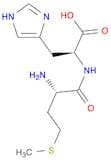
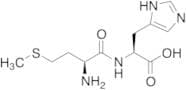
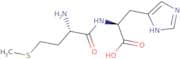
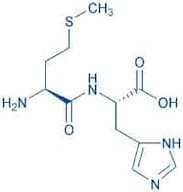
CAS 14486-12-5
:H-Met-His-OH
Description:
H-Met-His-OH, also known as N-Methyl-L-histidine, is a naturally occurring amino acid derivative that plays a role in various biological processes. It is characterized by the presence of a methyl group attached to the nitrogen atom of the imidazole side chain of histidine, which influences its biochemical properties. This compound is soluble in water and exhibits a zwitterionic nature at physiological pH, allowing it to participate in various metabolic pathways. H-Met-His-OH is often studied for its potential roles in muscle metabolism and protein synthesis, as well as its involvement in the regulation of certain physiological functions. Its structure allows it to interact with various enzymes and receptors, making it of interest in pharmacological research. Additionally, it can be synthesized through peptide coupling methods or derived from the hydrolysis of proteins containing histidine residues. Overall, H-Met-His-OH is a significant compound in biochemistry, with implications for health and disease.
Formula:C11H18N4O3S
Synonyms:- L-Methionyl-L-Histidine
Sort by
Purity (%)
0
100
|
0
|
50
|
90
|
95
|
100
Found 4 products.
H-Met-His-OH
CAS:H-Met-His-OH is a metabolite of methionine, which has been shown to have insulin sensitizing effects. H-Met-His-OH is produced from the reaction of methionine with hydrochloric acid and water molecule. This compound has been shown to modulate glucose metabolism by increasing insulin sensitivity in diabetic rats. It has also been shown to be able to increase estradiol levels in female mice, which may be due to its ability to inhibit protein synthesis. H-Met-His-OH also binds to histidine residues on the protein surface and may regulate protein kinetics via an unidentate mechanism.
Formula:C11H18N4O3SPurity:Min. 95%Molecular weight:286.35 g/molH-Met-His-OH
CAS:Bachem ID: 4008532.
Formula:C11H18N4O3SPurity:> 99%Color and Shape:White PowderMolecular weight:286.36