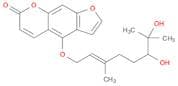
CAS 145414-76-2
:6′,7′-Dihydroxybergamottin
Description:
6′,7′-Dihydroxybergamottin is a naturally occurring compound classified as a furanocoumarin, primarily found in grapefruit and other citrus fruits. It is known for its potential role in influencing drug metabolism, particularly through its interaction with cytochrome P450 enzymes, which can affect the bioavailability of various pharmaceuticals. This compound features two hydroxyl groups at the 6′ and 7′ positions of the bergamottin structure, contributing to its chemical reactivity and biological activity. 6′,7′-Dihydroxybergamottin has garnered interest in pharmacology due to its ability to inhibit certain enzymes, which may lead to significant drug interactions when consumed with medications metabolized by these pathways. Additionally, it exhibits antioxidant properties, suggesting potential health benefits. Its molecular structure and properties make it a subject of study in both food chemistry and pharmacology, particularly concerning dietary influences on drug efficacy and safety. As with many furanocoumarins, caution is advised when considering its consumption alongside certain medications.
Formula:C21H24O6
InChI:InChI=1/C21H24O6/c1-13(4-6-18(22)21(2,3)24)8-10-26-20-14-5-7-19(23)27-17(14)12-16-15(20)9-11-25-16/h5,7-9,11-12,18,22,24H,4,6,10H2,1-3H3/b13-8+
InChI key:InChIKey=IXZUPBUEKFXTSD-MDWZMJQENA-N
SMILES:O(C/C=C(/CCC(C(C)(C)O)O)\C)C=1C2=C(C=C3C1C=CO3)OC(=O)C=C2
Synonyms:- 4-[[(2E)-6,7-Dihydroxy-3,7-dimethyl-2-octen-1-yl]oxy]-7H-furo[3,2-g][1]benzopyran-7-one
- 4-{[(2E)-6,7-dihydroxy-3,7-dimethyloct-2-en-1-yl]oxy}-7H-furo[3,2-g]chromen-7-one
- 6,7-Dihydroxybergagamottin
- 6′,7′-Dihydroxybergamottin
- 7H-Furo[3,2-g][1]benzopyran-7-one, 4-[(6,7-dihydroxy-3,7-dimethyl-2-octenyl)oxy]-, (E)-
- 7H-Furo[3,2-g][1]benzopyran-7-one, 4-[[(2E)-6,7-dihydroxy-3,7-dimethyl-2-octen-1-yl]oxy]-
- 7H-Furo[3,2-g][1]benzopyran-7-one, 4-[[(2E)-6,7-dihydroxy-3,7-dimethyl-2-octenyl]oxy]-
- Dihydroxybergamottin
Sort by
Purity (%)
0
100
|
0
|
50
|
90
|
95
|
100
Found 4 products.
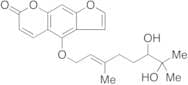
6',7'-Dihydroxy Bergamottin
CAS:Controlled ProductApplications A minor metabolite of Bergamottin (B318400). Metabolization of Bergamottin by cytochromes P 450 2B6 and 3A5.
References Lin, H., et al.: J. Pharmacol. Exp. Ther., 301, 160 (2002), Hesselink, D., et al.: Clin. Pharmacol. Ther., 74, 245 (2003), Evans, D., et al.: Chem. Res. Toxicol., 17, 3 (2004), Friesner, R., et al.: J. Med. Chem., 47, 1739 (2004), Bumpus, N., et al.: Drug Metab. Dispos., 33, 795 (2005),Formula:C21H24O6Color and Shape:NeatMolecular weight:372.416',7'-Dihydroxy bergamottin
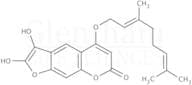
CAS:Bergamottin is a naturally occurring flavonoid that is found in grapefruit and other citrus fruit. It has been shown to inhibit the activity of the P-glycoprotein (P-gp) transporter in human cells, which may lead to drug interactions. A number of analytical methods have been developed for the determination of bergamottin in biological samples such as humans, rat liver microsomes, and natural compounds. Bergamottin has been shown to be a potent inhibitor of cytochrome P450 enzymes and can inhibit skin cancer development in mice by inhibiting the growth of human keratinocytes (HK-2 cells). Bergamottin also inhibits tumorigenesis in mice by decreasing cell proliferation and inducing apoptosis in hk-2 cells.Formula:C21H24O6Purity:Min. 95%Color and Shape:PowderMolecular weight:372.41 g/mol