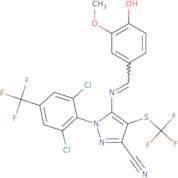
![1-[2,6-dichloro-4-(trifluoromethyl)phenyl]-5-{[(E)-(4-hydroxy-3-methoxyphenyl)methylidene]amino}-4…](/_next/image/?url=https%3A%2Fstatic.cymitquimica.com%2Fcas-image%2Fthumb-webp%2F501082-1-26-dichloro-4-trifluoromethyl-phenyl-5-e-4-hydroxy-3-methoxyphenyl-methylidene-amino-4-trifluoromethyl-sulfanyl-1h-pyrazole-3-carbonitrile.webp&w=3840&q=75)
CAS 145767-97-1
:1-[2,6-dichloro-4-(trifluoromethyl)phenyl]-5-{[(E)-(4-hydroxy-3-methoxyphenyl)methylidene]amino}-4-[(trifluoromethyl)sulfanyl]-1H-pyrazole-3-carbonitrile
Description:
The chemical substance known as 1-[2,6-dichloro-4-(trifluoromethyl)phenyl]-5-{[(E)-(4-hydroxy-3-methoxyphenyl)methylidene]amino}-4-[(trifluoromethyl)sulfanyl]-1H-pyrazole-3-carbonitrile, with CAS number 145767-97-1, is a complex organic compound characterized by its multi-functional groups. It features a pyrazole core, which is a five-membered ring containing two nitrogen atoms, and is substituted with various aromatic and functional groups, including dichloro and trifluoromethyl moieties. The presence of a carbonitrile group indicates potential reactivity, particularly in nucleophilic addition reactions. The compound also contains a hydroxy and methoxy group, which can influence its solubility and reactivity. Its structural complexity suggests potential applications in pharmaceuticals or agrochemicals, particularly due to the presence of halogenated groups that can enhance biological activity. The trifluoromethyl and sulfanyl groups may contribute to its electronic properties, making it an interesting candidate for further study in medicinal chemistry or material science.
Formula:C20H10Cl2F6N4O2S
InChI:InChI=1/C20H10Cl2F6N4O2S/c1-34-15-4-9(2-3-14(15)33)8-30-18-17(35-20(26,27)28)13(7-29)31-32(18)16-11(21)5-10(6-12(16)22)19(23,24)25/h2-6,8,33H,1H3/b30-8+
Synonyms:- 145767-97-1
- Vaniliprole
Sort by
Purity (%)
0
100
|
0
|
50
|
90
|
95
|
100
Found 1 products.
Vaniliprole
CAS:Vaniliprole is a vitamin analog that exhibits anticancer properties by inhibiting tumor growth and inducing apoptosis in cancer cells. It acts as a protein kinase inhibitor, which prevents the activation of kinases that play a crucial role in cell division and proliferation. Vaniliprole has been shown to be effective against various types of cancer cells, including those derived from humans and Chinese hamsters. This compound is excreted through urine and has potential as an anticancer agent for future drug development.Formula:C20H10Cl2F6N4O2SPurity:Min. 95%Molecular weight:555.3 g/mol