CAS 14581-89-6
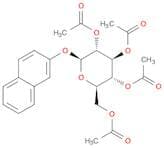
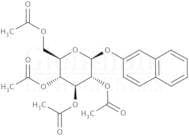
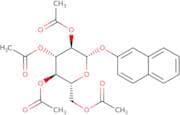
:b-Naphthyl b-D-Glucopyranoside Tetraacetate
Description:
β-Naphthyl β-D-glucopyranoside tetraacetate is a synthetic glycoside compound characterized by its structure, which includes a β-naphthyl group linked to a β-D-glucopyranoside moiety that is further acetylated at four hydroxyl positions. This compound is typically used in biochemical research, particularly in studies involving glycosidase enzymes, as it serves as a substrate for these enzymes. The tetraacetate form enhances its solubility and stability, making it suitable for various experimental conditions. It is generally a white to off-white solid, and its solubility in organic solvents varies, often being more soluble in polar solvents. The compound's reactivity is influenced by the presence of the acetyl groups, which can be hydrolyzed under specific conditions, releasing the active β-naphthyl glycoside. Its CAS number, 14581-89-6, allows for easy identification in chemical databases and literature. Overall, β-naphthyl β-D-glucopyranoside tetraacetate is a valuable tool in enzymology and carbohydrate chemistry.
Formula:C24H26O10
InChI:InChI=1/C24H26O10/c1-13(25)29-12-20-21(30-14(2)26)22(31-15(3)27)23(32-16(4)28)24(34-20)33-19-10-9-17-7-5-6-8-18(17)11-19/h5-11,20-24H,12H2,1-4H3/t20?,21-,22+,23+,24-/m1/s1
Synonyms:- 2-Naphthalenyl b-D-Glucopyranoside Tetraacetate
- 2-Naphthyl b-D-Glucopyranoside Tetraacetat
- 2-Naphthalenyl -D-Glucopyranoside Tetraacetate
- 2-Naphthyl -D-Glucopyranoside Tetraacetate
- -Naphthyl -D-Glucopyranoside Tetraacetate
Sort by
Purity (%)
0
100
|
0
|
50
|
90
|
95
|
100
Found 4 products.
beta-Naphthyl beta-D-Glucopyranoside Tetraacetate
CAS:Controlled ProductApplications β-Naphthyl β-D-Glucopyranoside Tetraacetate (cas# 14581-89-6) is a compound useful in organic synthesis.
Formula:C24H26O10Color and Shape:NeatMolecular weight:474.462-Naphthyl 2,3,4,6-tetra-O-acetyl-b-D-glucopyranoside
CAS:2-Naphthyl 2,3,4,6-tetra-O-acetyl-b-D-glucopyranoside (NAG tetra acetate) is a chromogenic enzyme substrate commonly used in the detection of β-galactosidase activity. Upon hydrolysis by the enzyme, it produces a yellow product that can be detected by spectrophotometry or visually. It is frequently used in bacterial assays to monitor gene expression or as a tool for screening potential inhibitors of the enzyme.Purity:Min. 95%Molecular weight:474.47 g/mol