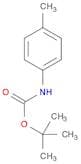
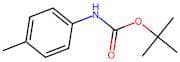
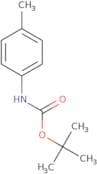
CAS 14618-59-8
:Carbamic acid, N-(4-methylphenyl)-, 1,1-dimethylethyl ester
Description:
Carbamic acid, N-(4-methylphenyl)-, 1,1-dimethylethyl ester, commonly referred to by its CAS number 14618-59-8, is an organic compound that belongs to the class of carbamates. This substance is characterized by its ester functional group, which is formed from the reaction of carbamic acid and an alcohol. It typically appears as a colorless to pale yellow liquid with a distinctive odor. The compound is known for its moderate solubility in organic solvents and limited solubility in water, which is a common trait among many carbamates. It exhibits properties such as being a potential intermediate in organic synthesis and may have applications in agriculture as a pesticide or herbicide. Additionally, like many carbamate derivatives, it may possess biological activity, influencing its use in various chemical processes. Safety data should be consulted, as carbamates can exhibit toxicity to humans and wildlife, necessitating careful handling and usage in laboratory and industrial settings.
Formula:C12H17NO2
InChI:InChI=1S/C12H17NO2/c1-9-5-7-10(8-6-9)13-11(14)15-12(2,3)4/h5-8H,1-4H3,(H,13,14)
InChI key:InChIKey=GNUJXPOJGTXSEZ-UHFFFAOYSA-N
SMILES:N(C(OC(C)(C)C)=O)C1=CC=C(C)C=C1
Synonyms:- tert-Butyl p-tolylcarbamate
- Carbamic acid, N-(4-methylphenyl)-, 1,1-dimethylethyl ester
- Carbamic acid, (4-methylphenyl)-, 1,1-dimethylethyl ester
- tert-Butyl p-methylphenylcarbamate
- Carbanilic acid, p-methyl-, tert-butyl ester
Sort by
Purity (%)
0
100
|
0
|
50
|
90
|
95
|
100
Found 4 products.
tert-Butyl N-(4-methylphenyl)carbamate
CAS:Formula:C12H17NO2Purity:98%Color and Shape:SolidMolecular weight:207.2689tert-Butyl N-(4-methylphenyl)carbamate
CAS:Tert-butyl N-(4-methylphenyl)carbamate is a reusable, efficient method for the synthesis of tert-butyl carbamates from amines and carbon dioxide. This reaction is an example of a C–H bond activation that proceeds through an anion intermediate. The reaction time can be reduced by irradiation to increase the efficiency. Electrons are unpaired during this process, which is modeled with quantum mechanics software. Chloride is used as a catalyst to activate the electron and generate a reactive intermediate. Amine functionalities are added to the molecule in order to give it desired properties. The chloride group can be replaced with other anions such as bromide or iodide, which will also introduce different reactivity patterns.Formula:C12H17NO2Purity:Min. 95%Molecular weight:207.27 g/mol