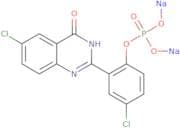
![4(1H)-Quinazolinone, 6-chloro-2-[5-chloro-2-(phosphonooxy)phenyl]-,disodium salt](/_next/image/?url=https%3A%2Fstatic.cymitquimica.com%2Fcas-image%2Fthumb-webp%2F337056-4-1h-quinazolinone-6-chloro-2-5-chloro-2-phosphonooxy-phenyl-disodium-salt.webp&w=3840&q=75)
CAS 146508-65-8
:4(1H)-Quinazolinone, 6-chloro-2-[5-chloro-2-(phosphonooxy)phenyl]-,disodium salt
Description:
4(1H)-Quinazolinone, 6-chloro-2-[5-chloro-2-(phosphonooxy)phenyl]-, disodium salt, identified by CAS number 146508-65-8, is a chemical compound characterized by its quinazolinone core structure, which is a bicyclic compound containing a fused benzene and pyrimidine ring. The presence of chlorine substituents and a phosphonooxy group contributes to its unique reactivity and potential biological activity. As a disodium salt, it is likely to exhibit increased solubility in aqueous environments, making it suitable for various applications in medicinal chemistry and biochemistry. This compound may possess properties that are of interest in the development of pharmaceuticals, particularly in targeting specific biological pathways. Its structural features suggest potential interactions with enzymes or receptors, which could be explored for therapeutic purposes. However, detailed studies would be necessary to fully elucidate its pharmacological profile and potential applications.
Formula:C14H9Cl2N2O5P・2Na
Sort by
Purity (%)
0
100
|
0
|
50
|
90
|
95
|
100
Found 1 products.
FLsharp™ - Phosphate, disodium salt
CAS:FLsharp™ - Phosphate, disodium salt is a fluorogenic water soluble substrate for phosphatase enzymes. After cleavage of the substrate by phosphatase activity an insoluble product is formed that is highly fluorescent in the solid state. Upon UV irradiation this very stable fluorophore emits green light in the 530 nm range for an extended period of time. FLsharp™ - Phosphate is a unique substrate - optimized for the detection of phosphatase activity in solid matrices such as agar media, tissuesections or microscopic preparations. FLsharp™ - Phosphate, disodium salt is used in microbiology as asubstrate for bacterial phosphatases. The substrate is suitable to detect the specific phosphatase activity of S. aureus or C. perfringensin food samples or clinical samples. Colonies growing on plating media supplemented with FLsharp™ emit green light upon UV light excitation(Excitation max: 365 nm; emission max: 530 nm). The enzyme product formed from FLsharp™ in agar plating media enables high precision for the localization of the relevant colonies on the plate. As a result small bacteria colonies of phosphatase-positive bacteria can be detected already after a short incubation time. In cytochemical and histochemical imaging FLsharp™ - Phosphate, disodiumsalt can be used as a substrate for Alkaline Phosphatase (AP)-coupled antibodies. The fluorophore that is released from FLsharp™ - Phosphateby phosphatase activity will precipitate. This insoluble fluorophoreen ables a precise localization of the antibody-bound epitope in cells or tissues under a fluorescence microscope or fluorescence imaging system. The green fluorescence of FLsharp™ can be clearly differentiated from autofluorescence or counterstainings such as (blue) DAPI or (red) Alexafluorophores.Formula:C14H7Cl2N2Na2O5PPurity:Min. 95.0 Area-%Molecular weight:431.08 g/mol