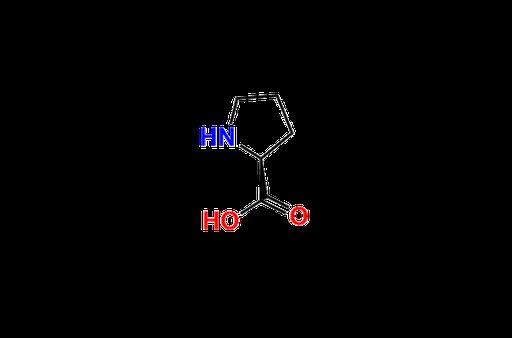
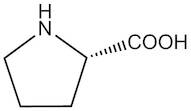
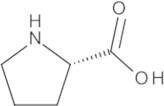
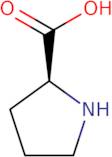
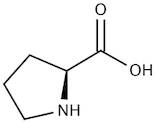
CAS 147-85-3
:L(-)-Proline
- (-)-(S)-Proline
- (2S)-Pyrrolidine-2-carboxylic acid
- (S)-2-Carboxypyrrolidine
- (S)-2-Pyrrolidinecarboxylic acid
- (S)-Pyrrolidine-2-carboxylic acid
- 2-Pyrrolidine carboxylic acid
- 2-Pyrrolidinecarboxylic acid
- 2-Pyrrolidinecarboxylic acid, (S)-
- 21: PN: WO2021055880 SEQID: 22 claimed protein
- 28: PN: US20080058276 PAGE: 11 claimed protein
- <span class="text-smallcaps">L</span>-(-)-Proline
- <span class="text-smallcaps">L</span>-Pyrrolidine-2-carboxylic acid
- <span class="text-smallcaps">L</span>-α-Pyrrolidinecarboxylic acid
- Carboxypyrrolidine
- H-Pro-OH
- L-Prolin
- L-Pyrrolidine-2-carboxylic acid
- L-prolina
- L-α-Pyrrolidinecarboxylic acid
- Nsc 46703
- Proline
- Proline, <span class="text-smallcaps">L</span>-
- Proline, L-
- L-(-)-proline:
- L-Proline
- See more synonyms
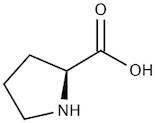
L-Proline
CAS:Amino acidFormula:C5H9NO2Purity:≥ 98.0 % (HPLC)Color and Shape:PowderMolecular weight:115.13L-Proline
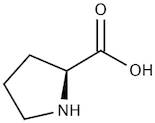
CAS:Applications L-Proline is an amino acid and precursor (with vitamin C) for collagen, the building block of the structure of tendons, ligaments, arteries, veins and muscles. It is important in wound healing.
References Bondarenko, L.B., et al.: Int. J. Peptides., 2, 1687 (2012); Rimer, T., et al.: Biomacromolecules, 13, 2110 (2012);Formula:C5H9NO2Color and Shape:NeatMolecular weight:115.13L-Proline-13C5,15N
CAS:Stability Hygroscopic
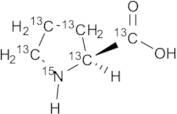
Applications L-Proline-13C5,15N is isotope labelled form of L-Proline (P755995), which is an amino acid and precursor (with vitamin C) for collagen, the building block of the structure of tendons, ligaments, arteries, veins and muscles. It is also important in wound healing.
References Bondarenko, L.B., et al.: Int. J. Peptides., 2, 1687 (2012); Rimer, T., et al.: Biomacromolecules, 13, 2110 (2012);Formula:C5H915NO2Color and Shape:NeatMolecular weight:121.09L-Proline
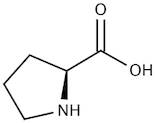
CAS:L-Proline is a small molecule drug that can be synthesized by plants. It is a nonessential amino acid with biological properties such as proline, which is a constituent of collagen and the precursor to other amino acids. L-Proline has been shown to have locomotor activity in vivo and in vitro assays, as well as enzyme activities that are involved in mitochondrial functions and polymerase chain reactions. It also has transcriptional regulation properties and can be used for the treatment of Parkinson's disease. L-Proline is also believed to have antioxidant effects due to its ability to bind metals.
Formula:C5H9NO2Purity:Min. 95%Color and Shape:White PowderMolecular weight:115.13 g/molL-Proline for tissue culture, 99%
CAS:Formula:C5H9NO2Purity:min. 99%Color and Shape:White, Crystalline powder, Clear, ColourlessMolecular weight:115.13L-Proline for cell culture, 99%, Endotoxin (BET) 1.0EU/mg
CAS:Formula:C5H9NO2Purity:min. 99%Color and Shape:White, Crystalline powder, Clear, ColourlessMolecular weight:115.13L-Proline USP
CAS:Formula:C5H9NO2Purity:98.5 - 101.5%Color and Shape:White , odorless, CrystalsMolecular weight:115.13Proline BP
CAS:Formula:C5H9NO2Purity:98.5 - 101.0%Color and Shape:White or almost white, colourless, Crystalline powder or crystals, 2.5g in 50ml water is clear and colourlessMolecular weight:115.13L-Proline ExiPlus, Multi-Compendial, 99%
CAS:Formula:C5H9NO2Purity:min. 99%Color and Shape:White, Crystalline powder, Clear, ColourlessMolecular weight:115.13L-Proline extrapure CHR, 99%
CAS:Formula:C5H9NO2Purity:min. 99%Color and Shape:White, Crystalline powder, Clear, ColourlessMolecular weight:115.13