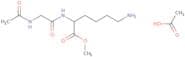
CAS 14752-92-2
:L-Lysine, N-acetylglycyl-, methyl ester, acetate (1:1)
Description:
L-Lysine, N-acetylglycyl-, methyl ester, acetate (1:1) is a chemical compound that features a combination of amino acids and functional groups. It is derived from lysine, an essential amino acid, which plays a crucial role in protein synthesis and various metabolic processes. The presence of the N-acetylglycyl group indicates that the lysine has been modified, potentially enhancing its solubility and bioavailability. The methyl ester functionality suggests that the compound may exhibit different properties compared to its free acid form, such as altered reactivity and stability. The acetate component implies that the compound is in a salt form, which can influence its solubility in aqueous solutions. This compound may be of interest in biochemical research, pharmaceuticals, and nutritional applications due to its potential roles in cellular functions and as a building block for peptides. However, specific applications and biological activities would depend on further studies and context regarding its use.
Formula:C11H21N3O4·C2H4O2
InChI:InChI=1S/C11H21N3O4.C2H4O2/c1-8(15)13-7-10(16)14-9(11(17)18-2)5-3-4-6-12;1-2(3)4/h9H,3-7,12H2,1-2H3,(H,13,15)(H,14,16);1H3,(H,3,4)/t9-;/m0./s1
InChI key:InChIKey=UNWQLIOZIACTGA-FVGYRXGTSA-N
SMILES:[C@H](NC(CNC(C)=O)=O)(CCCCN)C(OC)=O.C(C)(O)=O
Synonyms:- <span class="text-smallcaps">L</span>-Lysine, N-acetylglycyl-, methyl ester, acetate (1:1)
- <span class="text-smallcaps">L</span>-Lysine, N-acetylglycyl-, methyl ester, monoacetate
- <span class="text-smallcaps">L</span>-Lysine, N<sup>2</sup>-(N-acetylglycyl)-, methyl ester, monoacetate
- Ac-Gly-Lys-OMe
- Lysine, N<sup>2</sup>-(N-acetylglycyl)-, methyl ester, monoacetate, <span class="text-smallcaps">L</span>-
- Methyl 6-[(2-Acetamidoacetyl)Amino]-2-Amino-Hexanoate
- N-?-Acetylglycyl-L-lysine methyl ester acetate
- N-Acetyl-Gly-Lys Methyl Ester Acetate Salt
- N-Acetylglycyl-<span class="text-smallcaps">L</span>-lysine methyl ester acetate
- L-Lysine, N2-(N-acetylglycyl)-, methyl ester, monoacetate
- Lysine, N2-(N-acetylglycyl)-, methyl ester, monoacetate, L-
- L-Lysine, N-acetylglycyl-, methyl ester, acetate (1:1)
- See more synonyms
Sort by
Purity (%)
0
100
|
0
|
50
|
90
|
95
|
100
Found 3 products.
Ac-Gly-Lys-OMe acetate
CAS:Controlled ProductAc-Gly-Lys-OMe acetate salt is a reactive chemical compound that is used in the synthesis of peptides. This salt is synthesized by reacting glycine with lysine and formaldehyde. Ac-Gly-Lys-OMe acetate salt has been shown to have hemolytic activity and can be used as a synthetic substrate for kinetic studies. It has also been found to activate complement, which may be due to its disulfide bond formation. Ac-Gly-Lys-OMe acetate salt has been shown to inhibit fibrinogen and nitrosylation, which may result in thrombotic disorders.Formula:C11H21N3O4•C2H4O2Purity:Min. 95%Color and Shape:PowderMolecular weight:319.35 g/molAc-Gly-Lys-OMe • AcOH [AGLME]
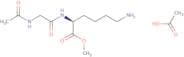
CAS:Ac-Gly-Lys-OMe • AcOH is a synthetic substrate that is used in enzymatic reactions. This product is a peptide that contains an amide bond and a disulfide bond. It has been shown to be inactive when exposed to human serum for up to 30 minutes. Ac-Gly-Lys-OMe • AcOH has been shown to have inhibitory effects on the activity of monoclonal antibodies as well as dodecyl, which belongs to the group of lipids found in blood plasma. The rate of this reaction increases with increasing temperature and pH, but decreases with increasing concentrations of AGLME or dodecanol.Formula:C11H21N3O4•CH3COOHPurity:Min. 95%Molecular weight:319.35 g/molAc-Val-Asp-Val-Ala-Asp-AMC
CAS:Controlled ProductAc-Val-Asp-Val-Ala-Asp-AMC is a research tool used to study the function of ion channels. It is an activator that binds to the receptor site on ATP sensitive potassium channels. Ac-Val-Asp-Val-Ala-Asp-AMC has been shown to inhibit calcium and sodium ion flux through ion channels, as well as high purity and good solubility. This peptide is useful for studying protein interactions, pharmacology, and life science research.
Formula:C33H44N6O12Purity:Min. 95%Molecular weight:716.74 g/mol

![Ac-Gly-Lys-OMe • AcOH [AGLME]](/_next/image/?url=https%3A%2Fstatic.cymitquimica.com%2Fproducts%2F3D%2Fthumb%2FSGK-3058.jpg&w=3840&q=75)