CAS 1484-13-5
:9-Vinylcarbazole
Description:
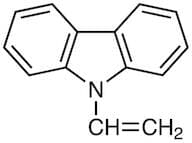
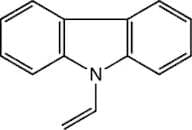
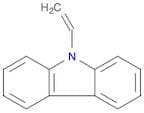
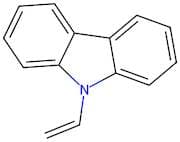
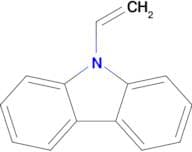
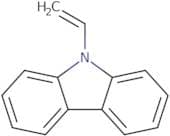
9-Vinylcarbazole is an organic compound characterized by its vinyl group attached to the nitrogen-containing carbazole structure. It has a molecular formula of C13H11N and features a fused ring system that contributes to its stability and unique properties. This compound is typically a white to light yellow crystalline solid and is known for its ability to undergo polymerization, making it useful in the production of various polymers and copolymers. 9-Vinylcarbazole exhibits photochemical properties, allowing it to be utilized in applications such as photoinitiators in UV-curable coatings and inks. Additionally, it has potential applications in organic electronics, particularly in the development of light-emitting diodes (LEDs) and photovoltaic devices due to its electron-donating characteristics. The compound is also of interest in the field of organic synthesis and materials science, where its reactivity can be harnessed for creating functionalized materials. Safety data should be consulted for handling and exposure guidelines, as with any chemical substance.
Formula:C14H11N
InChI:InChI=1/C14H11N/c1-2-10-6-5-8-12-11-7-3-4-9-13(11)15-14(10)12/h2-9,15H,1H2
InChI key:InChIKey=KKFHAJHLJHVUDM-UHFFFAOYSA-N
SMILES:C(=C)N1C=2C(C=3C1=CC=CC3)=CC=CC2
Synonyms:- 1-ethenyl-9H-carbazole
- 9-Vinilcarbazol
- 9-Vinyl-9H-carbazole
- 9-Vinylcarbazol
- 9-ethenyl-9H-carbazole
- 9H-Carbazole, 9-ethenyl-
- Carbazole, 9-vinyl-
- Hrm-C 01
- N-Ethenylcarbazole
- N-Vinyl carbazole
- N-vinylcarbazole
- Nsc 406868
- P 0656
- V 0021
- 9-Vinylcarbazole
- 9-Vinyl Carbizole
- 1-(9H-Carbazole-9-yl)ethene
- 9-VINYLCARBAZOLE MONOMER
- 9-vinyl-carbazol
- vinylcarbazole
- N-VINYLCARBAZOLE MONOMER
- 9-ethenyl-9h-carbazol
- n-vinylkarbazol
- See more synonyms
Sort by
Purity (%)
0
100
|
0
|
50
|
90
|
95
|
100
Found 7 products.
9-Vinylcarbazole
CAS:Formula:C14H11NPurity:>98.0%(GC)Color and Shape:White to Light yellow powder to crystalMolecular weight:193.259-Vinylcarbazole, 98+%
CAS:9-Vinylcarbazole is used as a monomer in the production of poly(vinylcarbazole), a conductive polymer, in which conductivity is photon-dependent. It is also used in the photoreceptors of photocopiers. This Thermo Scientific Chemicals brand product was originally part of the Alfa Aesar product portfoFormula:C14H11NPurity:98+%Molecular weight:193.259-Vinyl carbazole
CAS:9-Vinyl Carbazole is a polymerizable monomer that can be used for the production of polymeric materials. It has been shown to have antimicrobial properties when exposed to light and can be used in the development of light activated antimicrobial agents. 9-Vinyl Carbazole has also been shown to be cytotoxic in cells, with significant cell death being observed at very low concentrations. This compound has been shown to have a high degree of transport properties and can be used as a cationic surfactant. 9-Vinyl Carbazole is also known as methyl ethyl carbazole or MEC, which undergoes an electrophilic addition reaction mechanism. The molecule has an electron withdrawing group on the ring that reacts with a nucleophile, such as trifluoroacetic acid (TFA), yielding an electron-rich aromatic ring that undergoes cationic polymerization reactions. This reaction is catalyzed by a cationic surfactFormula:C14H11NPurity:Min. 95%Color and Shape:PowderMolecular weight:193.24 g/mol