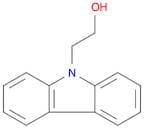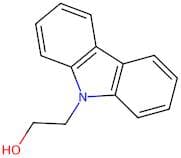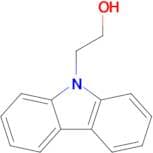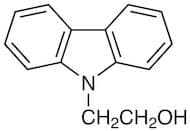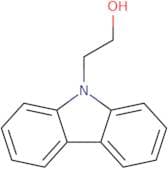
CAS 1484-14-6
:Carbazole-9-ethanol
Description:
Carbazole-9-ethanol, with the CAS number 1484-14-6, is an organic compound that features a carbazole structure, which is a fused bicyclic system consisting of a dibenzopyrrole core. This compound is characterized by the presence of a hydroxyl (-OH) group attached to the 9-position of the carbazole ring, which contributes to its solubility and reactivity. Carbazole-9-ethanol is typically a solid at room temperature and exhibits moderate polarity due to the hydroxyl group. It is known for its potential applications in organic electronics, particularly in the development of light-emitting diodes (LEDs) and as a hole transport material in organic photovoltaic cells. Additionally, the compound may exhibit interesting photophysical properties, making it a subject of research in the fields of materials science and organic chemistry. Its synthesis often involves the functionalization of carbazole derivatives, and it can be analyzed using various spectroscopic techniques to confirm its structure and purity.
Formula:C14H13NO
InChI:InChI=1S/C14H13NO/c16-10-9-15-13-7-3-1-5-11(13)12-6-2-4-8-14(12)15/h1-8,16H,9-10H2
InChI key:InChIKey=IIKVAWLYHHZRGV-UHFFFAOYSA-N
SMILES:C(CO)N1C=2C(C=3C1=CC=CC3)=CC=CC2
Synonyms:- 2-(9-Carbazolyl)ethanol
- 2-(9H-Carbazol-9-yl)ethan-1-ol
- 2-(9H-carbazol-9-yl)ethanol
- 2-(N-Carbazolyl)ethanol
- 9-(2-Hydroxyethyl)-9H-carbazole
- 9-(2-Hydroxyethyl)carbazole
- 9H-Carbazole-9-Ethanol
- 9H-Carbazole-ethanolCarbazole-9-ethanol
- Carbazole-9-ethanol
- N-(2-Hydroxyethyl)carbazole
- N-(Hydroxyethyl)carbazole
- N-(β-Hydroxyethyl)carbazole
- See more synonyms
Sort by
Purity (%)
0
100
|
0
|
50
|
90
|
95
|
100
Found 5 products.
2-(9H-Carbazol-9-yl)ethanol
CAS:Formula:C14H13NOPurity:>95.0%(GC)Color and Shape:White to Light yellow powder to crystalMolecular weight:211.269-(2-Hydroxyethyl)-carbazole
CAS:9-(2-Hydroxyethyl)-carbazole (HEC) is a carbazole with a red shift. It is synthesized by the reaction of 4-nitrophenylacetic acid with fatty acids and has been used as an acceptor in cationic polymerization. When exposed to light, HEC can emit blue fluorescence. The HEC molecule has a ring structure that includes an acceptor group, which enhances its fluorescence properties. HEC copolymers have been shown to exhibit increased light stability when exposed to heat and ultraviolet radiation. HEC copolymers can be used as a protective coating for polymeric materials such as plastics, textiles, and rubber.Formula:C14H13NOPurity:Min. 95%Color and Shape:Off-White PowderMolecular weight:211.26 g/mol