CAS 14894-77-0
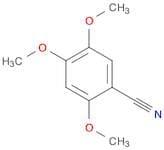
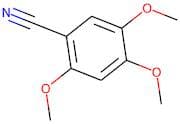
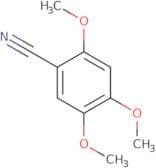
:2,4,5-Trimethoxybenzonitrile
Description:
2,4,5-Trimethoxybenzonitrile is an organic compound characterized by its aromatic structure, featuring a benzene ring substituted with three methoxy groups and a nitrile functional group. The methoxy groups, which are -OCH3, are located at the 2, 4, and 5 positions on the benzene ring, contributing to the compound's overall polarity and reactivity. The presence of the nitrile (-C≡N) group introduces a strong electron-withdrawing characteristic, influencing the compound's chemical behavior and potential applications. This compound is typically a white to off-white solid and is soluble in organic solvents, reflecting its hydrophobic nature due to the aromatic system. 2,4,5-Trimethoxybenzonitrile may be utilized in various chemical syntheses, including the development of pharmaceuticals and agrochemicals, owing to its functional groups that can participate in further chemical reactions. Additionally, its structural features may impart specific biological activities, making it of interest in medicinal chemistry research. Safety data should be consulted for handling and storage, as with any chemical substance.
Formula:C10H11NO3
InChI:InChI=1/C10H11NO3/c1-12-8-5-10(14-3)9(13-2)4-7(8)6-11/h4-5H,1-3H3
SMILES:COc1cc(c(cc1C#N)OC)OC
Sort by
Purity (%)
0
100
|
0
|
50
|
90
|
95
|
100
Found 4 products.
Benzonitrile, 2,4,5-trimethoxy-
CAS:Formula:C10H11NO3Purity:95%Color and Shape:SolidMolecular weight:193.19922,4,5-Trimethoxybenzonitrile
CAS:2,4,5-Trimethoxybenzonitrile is a reagent that is used in organic chemistry. It can be used to cleave a bond between two atoms. It is catalyzed by the presence of azide and nitriles and has been shown to induce cleavage of the C-N bond in etravirine with copper. This compound is also useful for synthesizing nanoparticles from organic compounds.Formula:C10H11NO3Purity:Min. 95%Color and Shape:PowderMolecular weight:193.20 g/mol