

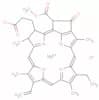
CAS 14897-06-4
:chlorophyllide a
Description:
Chlorophyllide a is a chlorophyll derivative that plays a crucial role in photosynthesis, primarily found in plants, algae, and cyanobacteria. It is a green pigment that absorbs light energy, facilitating the conversion of solar energy into chemical energy. Structurally, chlorophyllide a is characterized by a porphyrin ring with a central magnesium ion, which is essential for its light-absorbing properties. Unlike chlorophyll a, chlorophyllide a lacks the phytol tail, making it more polar and soluble in water. This compound exhibits strong absorption in the blue and red regions of the light spectrum, which is vital for photosynthetic efficiency. Chlorophyllide a is also involved in various biochemical processes, including the synthesis of chlorophyll and the regulation of plant growth. Its presence is significant in studies related to plant physiology, ecology, and biochemistry, as it serves as an indicator of plant health and productivity. Additionally, chlorophyllide a has potential applications in food and cosmetic industries due to its antioxidant properties.
Formula:C35H34MgN4O5
InChI:InChI=1/C35H36N4O5.Mg/c1-8-19-15(3)22-12-24-17(5)21(10-11-28(40)41)32(38-24)30-31(35(43)44-7)34(42)29-18(6)25(39-33(29)30)14-27-20(9-2)16(4)23(37-27)13-26(19)36-22;/h8,12-14,17,21,31H,1,9-11H2,2-7H3,(H3,36,37,38,39,40,41,42);/q;+2/p-2/t17-,21-,31+;/m0./s1
InChI key:InChIKey=ANWUQYTXRXCEMZ-NYABAGMLSA-L
SMILES:CC1=C2[N-]3[Mg+2]45[N]=6C(=C7C3=C1C(=O)[C@@H]7C(OC)=O)[C@@H](CCC([O-])=O)[C@H](C)C6C=C8[N-]4C(=CC9=[N]5C(=C2)C(CC)=C9C)C(C=C)=C8C.[H+]
Synonyms:- 3-Phorbinepropanoic acid, 9-ethenyl-14-ethyl-21-(methoxycarbonyl)-4,8,13,18-tetramethyl-20-oxo-, magnesium complex, [3S-(3α,4β,21β)]-
- Magnesate(1-), (9-ethenyl-14-ethyl-21-(methoxycarbonyl)-4,8,13,18-tetramethyl-20-oxo-3-phorbinepropanoato(3-)-N23,N24,N25,N26)-, hydrogen, (SP-4-2-(3S-(3alpha,4beta,21beta)))-
- Magnesate(1-), [(3S,4S,21R)-9-ethenyl-14-ethyl-21-(methoxycarbonyl)-4,8,13,18-tetramethyl-20-oxo-3-phorbinepropanoato(3-)-κN<sup>23</sup>,κN<sup>24</sup>,κN<sup>25</sup>,κN<sup>26</sup>]-, hydrogen (1:1), (SP-4-2)-
- Magnesate(1-), [(3S,4S,21R)-9-ethenyl-14-ethyl-21-(methoxycarbonyl)-4,8,13,18-tetramethyl-20-oxo-3-phorbinepropanoato(3-)-κN<sup>23</sup>,κN<sup>24</sup>,κN<sup>25</sup>,κN<sup>26</sup>]-, hydrogen, (SP-4-2)-
- Magnesate(1-), [9-ethenyl-14-ethyl-21-(methoxycarbonyl)-4,8,13,18-tetramethyl-20-oxo-3-phorbinepropanoato(3-)-N<sup>23</sup>,N<sup>24</sup>,N<sup>25</sup>,N<sup>26</sup>]-, hydrogen, [SP-4-2-[3S-(3α,4β,21β)]]-
- Magnesate(1-), [9-ethenyl-14-ethyl-21-(methoxycarbonyl)-4,8,13,18-tetramethyl-20-oxo-3-phorbinepropanoato(3-)-κN<sup>23</sup>,κN<sup>24</sup>,κN<sup>25</sup>,κN<sup>26</sup>]-, hydrogen, [SP-4-2-[3S-(3α,4β,21β)]]-
- Magnesium, [dihydrogen 21-carboxy-14-ethyl-4,8,13,18-tetramethyl-20-oxo-9-vinyl-3-phorbinepropionato(2-)]-, 21-methyl ester
- Magnesium-pheophorbide A
- Phorbine, magnesate(1-) deriv.
- magnesium (3S,4S,21R)-3-(2-carboxyethyl)-9-ethenyl-14-ethyl-21-(methoxycarbonyl)-4,8,13,18-tetramethyl-20-oxo-23,25-didehydrophorbine-23,25-diide
- magnesium hydrogen 3-[9-ethenyl-14-ethyl-21-(methoxycarbonyl)-4,8,13,18-tetramethyl-20-oxido-23,25-didehydro-4,21-dihydro-3H-phorbin-23-id-3-yl]propanoate (1:1:1)
- Magnesate(1-), [(3S,4S,21R)-9-ethenyl-14-ethyl-21-(methoxycarbonyl)-4,8,13,18-tetramethyl-20-oxo-3-phorbinepropanoato(3-)-κN23,κN24,κN25,κN26]-, hydrogen (1:1), (SP-4-2)-
- Magnesate(1-), [(3S,4S,21R)-9-ethenyl-14-ethyl-21-(methoxycarbonyl)-4,8,13,18-tetramethyl-20-oxo-3-phorbinepropanoato(3-)-κN23,κN24,κN25,κN26]-, hydrogen, (SP-4-2)-
- Magnesate(1-), [9-ethenyl-14-ethyl-21-(methoxycarbonyl)-4,8,13,18-tetramethyl-20-oxo-3-phorbinepropanoato(3-)-κN23,κN24,κN25,κN26]-, hydrogen, [SP-4-2-[3S-(3α,4β,21β)]]-
- Chlorophyllide a
- See more synonyms
Sort by
Purity (%)
0
100
|
0
|
50
|
90
|
95
|
100
Found 1 products.
Chlorophyllide A
CAS:Chlorophyllide A is a chlorophyll molecule that has been synthesized by the enzymatic conversion of an existing chlorophyll molecule. It can be used as a model system for studying the physiological function of chlorophyll and its role in photosynthesis. The synthesis of Chlorophyllide A has been shown to be biocompatible with cells and tissues, making it an excellent candidate for drug delivery systems. The synthesis of this molecule is achieved through a reaction mechanism involving glutamate dehydrogenase, which adds a hydroxyl group to the cysteine residue on the chlorophyll molecule. This reaction takes place in low light conditions, which prevents photodegradation of this molecule. Chlorophyllide A also has a pH optimum at around pH 7-8 and does not react with proteins or nucleic acids.Formula:C35H34MgN4O5Purity:90%MinColor and Shape:PowderMolecular weight:614.97 g/mol

