CAS 149146-32-7
:Bacitracin B3 (9CI)
Description:
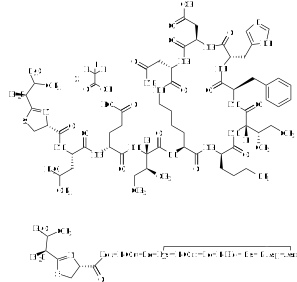
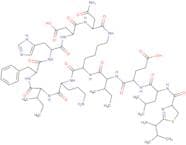
Bacitracin B3 (9CI) is a polypeptide antibiotic primarily derived from the bacterium Bacillus subtilis. It exhibits potent antibacterial activity, particularly against Gram-positive bacteria, making it valuable in both clinical and agricultural applications. The compound functions by inhibiting cell wall synthesis, which is crucial for bacterial growth and replication. Bacitracin B3 is characterized by its complex structure, which includes a cyclic peptide backbone and various amino acid residues that contribute to its biological activity. It is often used topically in ointments and creams to prevent infections in minor cuts and abrasions. Additionally, due to its effectiveness, it is sometimes included in animal feed to promote growth and prevent disease in livestock. However, its use is limited by potential nephrotoxicity when administered systemically, necessitating careful consideration of dosage and application routes. Overall, Bacitracin B3 is a significant compound in the field of antimicrobial therapy, with ongoing research into its mechanisms and potential applications.
Formula:C65H101N17O16S
Synonyms:- Bacitracin B1b
- L-Asparagine,N-[[2-(1-amino-2-methylpropyl)-4,5-dihydro-4-thiazolyl]carbonyl]-L-leucyl-D-a-glutamyl-L-isoleucyl-L-lysyl-D-ornithyl-L-isoleucyl-D-phenylalanyl-L-histidyl-D-a-aspartyl-, cyclic (10® 4)-peptide, [R-(R*,S*)]-
- BacitracinF,1-[N-[[2-(1-amino-2-methylpropyl)-4,5-dihydro-4-thiazolyl]carbonyl]-L-leucine]-
Sort by
Purity (%)
0
100
|
0
|
50
|
90
|
95
|
100
Found 3 products.
Bacitracin B1 Tritrifluoroacetate
CAS:Formula:C65H101N17O16S·3C2HF3O2Molecular weight:1408.69 3*114.02Bacitracin B3
CAS:Bacitracin B3 is an antibacterial agent, which is derived from the bacterium Bacillus subtilis. Its mode of action involves the inhibition of bacterial cell wall synthesis. This is achieved by interfering with the dephosphorylation of bactoprenol, an essential carrier molecule in the transport of peptidoglycan precursors across the cytoplasmic membrane. The disruption of this process leads to a weakened cell wall, ultimately resulting in bacterial cell lysis and death.Formula:C65H101N17O16SPurity:Min. 95%Molecular weight:1,408.7 g/mol