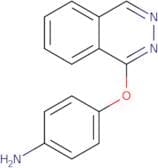
CAS 149365-40-2
:4-(phthalazin-1-yloxy)aniline
Description:
4-(Phthalazin-1-yloxy)aniline, with the CAS number 149365-40-2, is an organic compound characterized by its structural features, which include a phthalazin moiety linked to an aniline group via an ether bond. This compound typically exhibits properties associated with both aromatic amines and heterocyclic compounds, such as moderate solubility in organic solvents and potential reactivity due to the presence of the amino group. The phthalazin ring contributes to its stability and may influence its electronic properties, making it of interest in various chemical applications, including pharmaceuticals and materials science. Additionally, the compound may exhibit biological activity, which could be explored in medicinal chemistry contexts. Its synthesis often involves standard organic reactions, such as nucleophilic substitution or coupling reactions, and it may be characterized using techniques like NMR spectroscopy, mass spectrometry, and infrared spectroscopy to confirm its structure and purity. Overall, 4-(phthalazin-1-yloxy)aniline represents a versatile building block in organic synthesis and research.
Formula:C14H11N3O
InChI:InChI=1/C14H11N3O/c15-11-5-7-12(8-6-11)18-14-13-4-2-1-3-10(13)9-16-17-14/h1-9H,15H2
SMILES:c1ccc2c(c1)cnnc2Oc1ccc(cc1)N
Sort by
Purity (%)
0
100
|
0
|
50
|
90
|
95
|
100
Found 1 products.
4-(Phthalazin-1-yloxy)aniline
CAS:4-(Phthalazin-1-yloxy)aniline is an analog of cyclin-dependent kinase (CDK) inhibitors that has shown promising anticancer activity. It inhibits the activity of CDKs, which are enzymes involved in regulating cell division and proliferation. This compound has been tested on Chinese hamster ovary cells and has demonstrated potent antiproliferative activity against various cancer cell lines. 4-(Phthalazin-1-yloxy)aniline induces apoptosis in tumor cells, leading to their death. This compound may be a potential candidate for the development of novel anticancer drugs that target CDKs and promote tumor cell death. Additionally, this compound can be detected in urine samples, making it a useful biomarker for cancer diagnosis and monitoring.
Formula:C14H11N3OPurity:Min. 95%Molecular weight:237.26 g/molRef: 3D-ZFA36540
Discontinued product