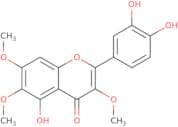
CAS 14965-20-9
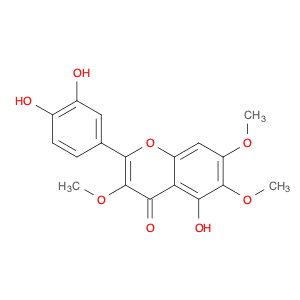
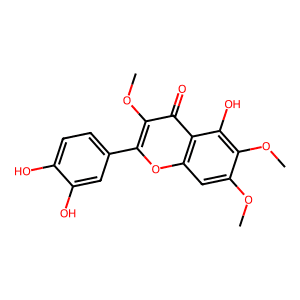
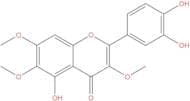
:2-(3,4-dihydroxyphenyl)-5-hydroxy-3,6,7-trimethoxy-4H-chromen-4-one
Description:
The chemical substance known as 2-(3,4-dihydroxyphenyl)-5-hydroxy-3,6,7-trimethoxy-4H-chromen-4-one, with the CAS number 14965-20-9, is a flavonoid compound characterized by its complex structure that includes multiple hydroxyl and methoxy groups. This compound belongs to the class of flavonoids, which are known for their diverse biological activities, including antioxidant, anti-inflammatory, and potential anticancer properties. The presence of hydroxyl groups enhances its ability to scavenge free radicals, contributing to its antioxidant capacity. The methoxy groups may influence its solubility and bioavailability. This compound is typically studied for its potential health benefits and applications in pharmaceuticals and nutraceuticals. Its structural features suggest that it may interact with various biological pathways, making it a subject of interest in medicinal chemistry and natural product research. Further studies are often conducted to explore its pharmacological effects and mechanisms of action in biological systems.
Formula:C18H16O8
InChI:InChI=1/C18H16O8/c1-23-12-7-11-13(14(21)17(12)24-2)15(22)18(25-3)16(26-11)8-4-5-9(19)10(20)6-8/h4-7,19-21H,1-3H3
SMILES:COc1cc2c(c(c1OC)O)c(=O)c(c(c1ccc(c(c1)O)O)o2)OC
Synonyms:- Chrysosplenol D
Sort by
Purity (%)
0
100
|
0
|
50
|
90
|
95
|
100
Found 5 products.
4H-1-Benzopyran-4-one, 2-(3,4-dihydroxyphenyl)-5-hydroxy-3,6,7-trimethoxy-
CAS:Formula:C18H16O8Purity:98%Color and Shape:SolidMolecular weight:360.3148Chrysosplenol D
CAS:Chrysosplenol D, an efflux pump inhibitor that can potentiate the activity of commercially important antibiotics and antimalarials.Formula:C18H16O8Purity:97.87% - 99.98%Color and Shape:SolidMolecular weight:360.31Chrysosplenol D
CAS:Chrysosplenol D is a sesquiterpene lactone that has been shown to have cytotoxic effects against cancer cells. It inhibits the growth of cancer cells by interfering with the synthesis of proteins necessary for cell division. Chrysosplenol D also inhibited tumor growth in animal models and showed a synergistic effect when combined with other anticancer drugs. The mechanism of action of chrysosplenol D involves the inhibition of mitochondrial membrane potential, c-jun phosphorylation, and efflux pump activity. This compound causes apoptosis in cancer cells by inhibiting the expression of amoena, which is necessary for cellular proliferation. Chrysosplenol D also inhibits cervical cancer growth through inhibition of human papilloma virus (HPV) E6/E7 mRNA expression in vitro.Formula:C18H16O8Purity:Min. 95%Color and Shape:PowderMolecular weight:360.3 g/mol