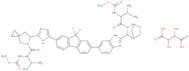
CAS 1499193-68-8
:Carbamic acid, N-[(1S)-1-[[(6S)-6-[5-[9,9-difluoro-7-[2-[(1R,3S,4S)-2-[(2S)-2-[(methoxycarbonyl)amino]-3-methyl-1-oxobutyl]-2-azabicyclo[2.2.1]hept-3-yl]-1H-benzimidazol-6-yl]-9H-fluoren-2-yl]-1H-imidazol-2-yl]-5-azaspiro[2.4]hept-5-yl]carbonyl]-2-methylpropyl]-, methyl ester, (2S,3S)-2,3-dihydroxybutanedioate (1:1)
Description:
Carbamic acid, N-[(1S)-1-[[[6S)-6-[5-[9,9-difluoro-7-[2-[(1R,3S,4S)-2-[(2S)-2-[(methoxycarbonyl)amino]-3-methyl-1-oxobutyl]-2-azabicyclo[2.2.1]hept-3-yl]-1H-benzimidazol-6-yl]-9H-fluoren-2-yl]-1H-imidazol-2-yl]-5-azaspiro[2.4]hept-5-yl]carbonyl]-2-methylpropyl]-, methyl ester, (2S,3S)-2,3-dihydroxybutanedioate is a complex organic compound characterized by its intricate molecular structure, which includes multiple functional groups such as carbamic acid, ester, and hydroxyl groups. This compound features a chiral center, indicating potential stereoisomerism, and contains several heterocyclic rings, contributing to its potential biological activity. The presence of difluoro and azabicyclic moieties suggests that it may exhibit unique chemical properties and reactivity. Its molecular weight and solubility characteristics would depend on the specific arrangement of its substituents. Given its complexity, this compound may be of interest in medicinal chemistry, particularly in the development of pharmaceuticals, due to its potential interactions with biological targets. Further studies would be necessary to elucidate its specific properties and applications.
Formula:C49H54F2N8O6·C4H6O6
InChI:InChI=1S/C49H54F2N8O6.C4H6O6/c1-24(2)39(56-46(62)64-5)44(60)58-23-48(15-16-48)21-38(58)42-52-22-37(55-42)28-9-13-32-31-12-8-26(18-33(31)49(50,51)34(32)19-28)27-10-14-35-36(20-27)54-43(53-35)41-29-7-11-30(17-29)59(41)45(61)40(25(3)4)57-47(63)65-6;5-1(3(7)8)2(6)4(9)10/h8-10,12-14,18-20,22,24-25,29-30,38-41H,7,11,15-17,21,23H2,1-6H3,(H,52,55)(H,53,54)(H,56,62)(H,57,63);1-2,5-6H,(H,7,8)(H,9,10)/t29-,30+,38-,39-,40-,41-;1-,2-/m00/s1
InChI key:InChIKey=ZQVLPYMRXLPMDX-KEAIDYLOSA-N
SMILES:C([C@@H](NC(OC)=O)[C@@H](C)C)(=O)N1CC2(C[C@H]1C=3NC(=CN3)C=4C=C5C(=CC4)C=6C(C5(F)F)=CC(=CC6)C=7C=C8C(=CC7)N=C(N8)[C@H]9N(C([C@@H](NC(OC)=O)C(C)C)=O)[C@]%10(C[C@@]9(CC%10)[H])[H])CC2.[C@H]([C@@H](C(O)=O)O)(C(O)=O)O
Synonyms:- Carbamic acid, N-[(1S)-1-[[(6S)-6-[5-[9,9-difluoro-7-[2-[(1R,3S,4S)-2-[(2S)-2-[(methoxycarbonyl)amino]-3-methyl-1-oxobutyl]-2-azabicyclo[2.2.1]hept-3-yl]-1H-benzimidazol-6-yl]-9H-fluoren-2-yl]-1H-imidazol-2-yl]-5-azaspiro[2.4]hept-5-yl]carbonyl]-2-methylpropyl]-, methyl ester, (2S,3S)-2,3-dihydroxybutanedioate (1:1)
Sort by
Purity (%)
0
100
|
0
|
50
|
90
|
95
|
100
Found 1 products.
Ledipasvir D-tartrate
CAS:Ledipasvir D-tartrate is an antiviral compound, which is a direct-acting antiviral agent used in the treatment of hepatitis C virus (HCV) infection. It originates from synthetic sources designed to inhibit the replication of specific viral proteins. Ledipasvir functions by targeting the NS5A protein of the hepatitis C virus, a key component necessary for viral replication. By binding to this protein, Ledipasvir disrupts and inhibits the HCV replication complex, effectively suppressing the viral load in patients.
Formula:C53H60F2N8O12Purity:Min. 95%Molecular weight:1,039.1 g/mol