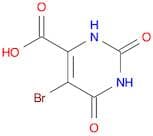
CAS 15018-62-9
:5-Bromo-1,2,3,6-tetrahydro-2,6-dioxo-4-pyrimidinecarboxylic acid
Description:
5-Bromo-1,2,3,6-tetrahydro-2,6-dioxo-4-pyrimidinecarboxylic acid is a heterocyclic organic compound characterized by its pyrimidine ring structure, which is substituted with a bromine atom and contains two carbonyl (oxo) groups. This compound typically exhibits properties associated with both acidic and basic functionalities due to the presence of the carboxylic acid group. Its molecular structure suggests potential reactivity, particularly in nucleophilic substitution reactions, owing to the electrophilic nature of the carbonyl groups. The bromine substituent can influence the compound's reactivity and solubility in various solvents. Additionally, the presence of multiple functional groups may confer biological activity, making it of interest in pharmaceutical chemistry. The compound's stability and behavior under different conditions, such as pH and temperature, can vary, impacting its applications in synthesis and research. Overall, 5-Bromo-1,2,3,6-tetrahydro-2,6-dioxo-4-pyrimidinecarboxylic acid is a versatile compound with potential utility in various chemical and biological contexts.
Formula:C5H3BrN2O4
InChI:InChI=1S/C5H3BrN2O4/c6-1-2(4(10)11)7-5(12)8-3(1)9/h(H,10,11)(H2,7,8,9,12)
InChI key:InChIKey=YQYHIPBLZSIHDI-UHFFFAOYSA-N
SMILES:C(O)(=O)C1=C(Br)C(=O)NC(=O)N1
Synonyms:- 5-Bromo-1,2,3,6-tetrahydro-2,6-dioxo-4-pyrimidinecarboxylic acid
- 5-Bromouracil-6-carboxylic acid
- Orotic acid, 5-bromo-
- 5-Bromoorotic acid
- 4-Pyrimidinecarboxylic acid, 5-bromo-1,2,3,6-tetrahydro-2,6-dioxo-
Sort by
Purity (%)
0
100
|
0
|
50
|
90
|
95
|
100
Found 2 products.
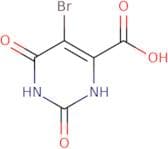
5-Bromo-2,6-dioxo-1,2,3,6-tetrahydropyrimidine-4-carboxylic acid
CAS:Formula:C5H3BrN2O4Molecular weight:234.99235-Bromoorotic acid
CAS:5-Bromoorotic acid is a chemical compound that contains one bromine atom. This compound has been shown to inhibit the growth of mammalian cells, which may be due to its ability to bind to DNA and interfere with protein synthesis. 5-Bromoorotic acid also has an inhibitory effect on radiation, which may be due to its ability to form stable complexes with electrons. 5-Bromoorotic acid has a helical structure, which may make it more stable than other compounds. It also inhibits the production of uridine by inhibiting uridine phosphorylase and nitro group production in g. lamblia, which is a parasitic protozoan that causes intestinal infections in humans.Formula:C5H3BrN2O4Purity:Min. 95%Color and Shape:White PowderMolecular weight:234.99 g/mol