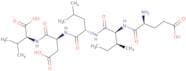
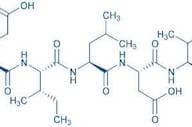
CAS 150525-67-0
:L-Valine, L-a-glutamyl-L-isoleucyl-L-leucyl-L-a-aspartyl-
Description:
The chemical substance known as "L-Valine, L-a-glutamyl-L-isoleucyl-L-leucyl-L-a-aspartyl-" is a peptide composed of several amino acids, specifically L-valine, L-glutamic acid, L-isoleucine, L-leucine, and L-aspartic acid. This compound is characterized by its structure, which includes a sequence of amino acids linked by peptide bonds, forming a polypeptide chain. It is likely to exhibit properties typical of peptides, such as solubility in water, depending on the specific amino acid composition and sequence. The presence of charged side chains from amino acids like glutamic acid and aspartic acid may contribute to its overall polarity and potential biological activity. Peptides like this one can play significant roles in biological processes, including acting as signaling molecules or influencing metabolic pathways. Additionally, the specific arrangement of amino acids can affect the compound's stability, reactivity, and interaction with other biomolecules. Overall, this substance represents a complex interplay of amino acids that may have implications in biochemistry and pharmacology.
Formula:C26H45N5O10
Sort by
Purity (%)
0
100
|
0
|
50
|
90
|
95
|
100
Found 2 products.
Fibronectin CS-1 Fragment (1978-1982)
CAS:Fibronectin CS-1 Fragment (1978-1982) H-Glu-Ile-Leu-Asp-Val-OH is a heterocyclic peptide that has inhibitory effects on the muscle cells. It inhibits the enzyme guanosine triphosphatase, which is responsible for releasing calcium ions from its intracellular storage site. Fibronectin CS-1 Fragment (1978-1982) H-Glu-Ile-Leu-Asp-Val-OH is an analog of the human protein fibronectin, and it can be used as a synthetic molecule to study how integrin receptors interact with different sequences of amino acids.Formula:C26H45N5O10Purity:Min. 95%Molecular weight:587.66 g/molFibronectin CS-1 Fragment (1978-1982)
CAS:EILDV and EILDVPST are derived from the type III connecting segment domain (IIICS) of fibronectin and have been found to promote tumor cell attachment after surface immobilization and to inhibit the experimental tumor metastasis of B16-BL6 melanoma. Hereby EILDV showed the strongest effect.Formula:C26H45N5O10Purity:96.4%Molecular weight:587.67