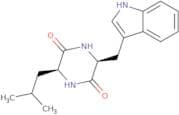
CAS 15136-34-2
:cyclo(L-leucyl-L-tryptophyl)
Description:
Cyclo(L-leucyl-L-tryptophyl), with the CAS number 15136-34-2, is a cyclic dipeptide composed of the amino acids leucine and tryptophan. This compound features a cyclic structure that enhances its stability compared to linear peptides. The presence of the hydrophobic leucine side chain contributes to its potential interactions with lipid membranes and proteins, while the indole side chain of tryptophan can participate in π-π stacking interactions and hydrogen bonding, influencing its biological activity. Cyclo(L-leucyl-L-tryptophyl) may exhibit various biological properties, including antimicrobial and antioxidant activities, making it of interest in pharmaceutical research. Its cyclic nature can also affect its solubility and permeability, which are critical factors in drug design. Additionally, the specific stereochemistry of the amino acids in the cyclic structure can influence its interaction with biological targets, potentially leading to unique pharmacological effects. Overall, this compound represents a fascinating area of study within peptide chemistry and its applications in medicinal chemistry.
Formula:C17H21N3O2
InChI:InChI=1/C17H21N3O2/c1-10(2)7-14-16(21)20-15(17(22)19-14)8-11-9-18-13-6-4-3-5-12(11)13/h3-6,9-10,14-15,18H,7-8H2,1-2H3,(H,19,22)(H,20,21)/t14-,15-/m0/s1
SMILES:CC(C)C[C@H]1C(=N[C@@H](Cc2c[nH]c3ccccc23)C(=N1)O)O
Synonyms:- Cyclo(leu-trp)
- 2,5-Piperazinedione, 3-(1H-indol-3-ylmethyl)-6-(2-methylpropyl)-, (3S-cis)-
- 2,5-Piperazinedione, 3-(indol-3-ylmethyl)-6-isobutyl-
- (3S,6S)-3-(1H-indol-3-ylmethyl)-6-(2-methylpropyl)piperazine-2,5-dione
- Cyclo(L-leucyl-L-tryptophyl)
Sort by
Purity (%)
0
100
|
0
|
50
|
90
|
95
|
100
Found 2 products.
Cyclo(L-Leu-L-Trp)
CAS:<p>Cyclo(L-Leu-L-Trp) is a diketopiperazine metabolite initially derived from Penicillium, exhibiting antibacterial (MICs = 125-1000 µg/ml) and antifungal activities (MICs = 8-64 µg/ml). It also demonstrates antioxidant properties by reducing the production of hydroxy radicals, as evidenced in an electron spin resonance (ESR) spectroscopy assay (IC50 = 1.8 µM). Additionally, Cyclo(L-Leu-L-Trp) has been identified as a bitter compound capable of quickly crossing rat taste cell membranes ex vivo at a 1 mM concentration. Furthermore, it acts as a melatonin receptor agonist in X. laevis melanophores, suppressing cAMP accumulation at a 20 µM concentration, with this effect being negated by the melatonin receptor antagonist luzindole.</p>Formula:C17H21N3O2Color and Shape:SolidMolecular weight:299.374Cyclo(-Leu-Trp)
CAS:<p>Cyclo(-Leu-Trp) is a sweetener that has been used in the food industry for many years. Cyclo(-Leu-Trp) is able to bind with quinine and form a complex that can be detected using analytical methods. Cyclo(-Leu-Trp) has been investigated as a ligand that may be able to bind to receptors on cancer cells, which could lead to new treatments for cancer. Cyclo(-Leu-Trp) also has amphipathic properties and can form liposomes at high concentrations. This molecule has also been studied for its ability to induce transduction of DNA into bacterial cells and cellular thermogenesis.</p>Formula:C17H21N3O2Purity:Min. 98 Area-%Color and Shape:PowderMolecular weight:299.37 g/mol