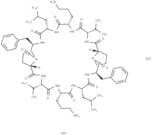
CAS 15207-30-4
:gramicidin S hydrochloride from*bacillus brevis (
Description:
Gramicidin S hydrochloride, derived from the bacterium Bacillus brevis, is a cyclic polypeptide antibiotic known for its broad-spectrum antibacterial properties. It is characterized by its ability to disrupt bacterial cell membrane integrity, leading to cell lysis. The compound is typically soluble in water and exhibits a high degree of stability under acidic conditions, which is beneficial for its formulation in various pharmaceutical applications. Gramicidin S is particularly effective against Gram-positive bacteria and is often used in topical preparations for treating skin infections. Its mechanism of action involves the formation of ion-permeable channels in the bacterial membrane, which alters membrane potential and disrupts essential cellular processes. Additionally, it has been noted for its low toxicity in humans, making it a valuable option in clinical settings. However, resistance can develop, necessitating careful consideration of its use in therapeutic regimens. Overall, gramicidin S hydrochloride remains an important compound in the field of antimicrobial agents.
Formula:C60H94Cl2N12O10
InChI:InChI=1/C60H92N12O10.2ClH/c1-35(2)31-43-53(75)67-45(33-39-19-11-9-12-20-39)59(81)71-29-17-25-47(71)55(77)70-50(38(7)8)58(80)64-42(24-16-28-62)52(74)66-44(32-36(3)4)54(76)68-46(34-40-21-13-10-14-22-40)60(82)72-30-18-26-48(72)56(78)69-49(37(5)6)57(79)63-41(23-15-27-61)51(73)65-43;;/h9-14,19-22,35-38,41-50H,15-18,23-34,61-62H2,1-8H3,(H,63,79)(H,64,80)(H,65,73)(H,66,74)(H,67,75)(H,68,76)(H,69,78)(H,70,77);2*1H/t41-,42-,43-,44-,45+,46+,47-,48-,49-,50-;;/m0../s1
Synonyms:- cyclo(L-leucyl-D-phenylalanyl-L-prolyl-L-valyl-L-ornithyl-L-leucyl-D-phenylalanyl-L-prolyl-L-valyl-L-ornithyl) dihydrochloride
Sort by
Purity (%)
0
100
|
0
|
50
|
90
|
95
|
100
Found 2 products.
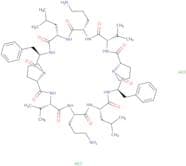
Gramicidin S 2HCl
CAS:Gramicidin S 2HCl, is an antibiotic. At concentrations of 40-80 μg/mL, GS can reduce planktonic cell numbers within 20-40 minutes. For established biofilms, it effectively kills cells at concentrations of 100-200 μg/mL without regrowth. This anti-biofilm effect results from peptide transmembrane transport and complexation with intracellular nucleotides (including the alarmone ppGpp). GS demonstrates wide-ranging activity against biofilm-forming, drug-resistant infections caused by E. faecalis, proving its efficacy in endodontic treatment. The successful treatment of persistent infections in two volunteer cases further confirms GS's potent therapeutic performance. These studies indicate that GS can be applied in certifying compounds used in endodontics.Formula:C60H94Cl2N12O10Color and Shape:SolidMolecular weight:1214.37Gramicidin S hydrochloride
CAS:Gramicidin S hydrochloride is a cyclic peptide antibiotic, which is a derivative of the naturally occurring antibiotic gramicidin S. It is sourced from Bacillus brevis, a type of soil bacterium. This peptide operates through a unique mode of action, whereby it disrupts bacterial cell membranes. By integrating into the lipid bilayer, it increases membrane permeability, leading to leakage of essential ions and molecules, and ultimately causing cell death.Formula:C60H92N12O10•(HCl)2Purity:90%MinMolecular weight:1,214.37 g/mol