CAS 1522-00-5
:4-(Diethylamino)-4-oxobutanoic acid
Description:
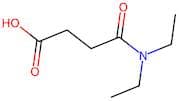
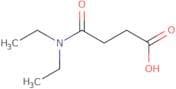
4-(Diethylamino)-4-oxobutanoic acid, with the CAS number 1522-00-5, is an organic compound characterized by its structure, which includes a diethylamino group and a keto group adjacent to a carboxylic acid. This compound typically appears as a white to off-white solid and is soluble in polar solvents due to the presence of the carboxylic acid functional group. It exhibits properties typical of amino acids and can participate in various chemical reactions, including esterification and amidation. The diethylamino group imparts basic characteristics, allowing it to act as a weak base. This compound is of interest in various fields, including medicinal chemistry and organic synthesis, due to its potential applications in drug development and as an intermediate in the synthesis of other chemical entities. Its reactivity and functional groups make it a versatile building block in organic chemistry. Safety data should be consulted for handling and storage, as with all chemical substances.
Formula:C8H15NO3
InChI:InChI=1S/C8H15NO3/c1-3-9(4-2)7(10)5-6-8(11)12/h3-6H2,1-2H3,(H,11,12)
InChI key:InChIKey=XILORGWKMLOGKF-UHFFFAOYSA-N
SMILES:N(C(CCC(O)=O)=O)(CC)CC
Synonyms:- 3-(Diethylcarbamoyl)propionic acid
- 4-(Diethylamino)-4-oxobutanoic acid
- Ai3-06303
- Brn 1772287
- Butanoic acid, 4-(diethylamino)-4-oxo-
- Butanoic acid, 4-(diethylamino)-4-oxo- (9CI)
- Mg 164
- Monodietilamide dell'acido succinico
- Monodietilamide dell'acido succinico [Italian]
- N,N-Diethylsuccinamic acid
- N,N-Diethylsuccinic acid monoamide
- Nsc 526
- Succinamic acid, N,N-diethyl-
- See more synonyms
Sort by
Purity (%)
0
100
|
0
|
50
|
90
|
95
|
100
Found 2 products.
4-(Diethylamino)-4-oxobutanoic acid
CAS:4-(Diethylamino)-4-oxobutanoic acidPurity:97%Molecular weight:173.21g/mol3-(Diethylcarbamoyl)propanoic acid
CAS:3-(Diethylcarbamoyl)propanoic acid is a prodrug that is hydrolyzed in vivo to the active form, 3-diethylamino-2-propanol. This compound has analgesic and antiinflammatory properties due to its ability to inhibit prostaglandin synthesis. 3-(Diethylcarbamoyl)propanoic acid has been shown to be effective against ureaplasmas, mycoplasmas, chlamydia and some viruses. It also inhibits the replication of prions and parasites such as worms and flukes.Formula:C8H15NO3Purity:Min. 95%Molecular weight:173.21 g/mol