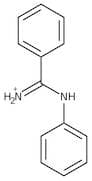
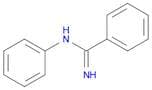
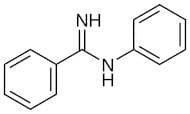
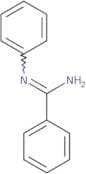
CAS 1527-91-9
:N-Phenylbenzamidine
- N1-Phenylbenzene-1-carboximidamide
- N'-phenylbenzenecarboximidamide
- N-[(1Z)-amino(phenyl)methylidene]anilinium
N-Phenylbenzamidine, 97%
CAS:This Thermo Scientific Chemicals brand product was originally part of the Alfa Aesar product portfolio. Some documentation and label information may refer to the legacy brand. The original Alfa Aesar product / item code or SKU reference has not changed as a part of the brand transition to Thermo Sci
Formula:C13H13N2Purity:97%Color and Shape:Powder, White to pale creamMolecular weight:197.26N-Phenylbenzimidamide
CAS:Formula:C13H12N2Purity:>98.0%(GC)Color and Shape:White to Light yellow powder to crystalMolecular weight:196.25N-Phenylbenzamidine
CAS:N-Phenylbenzamidine is a bicyclic heterocycle that has been synthesized and characterized as an amide. Its functional theory is based on the molecule's nucleophilic nature. The sodium hydrogen tautomeric form of N-phenylbenzamidine can be obtained by acidifying the molecule in water, which results in a chloride ion being released. The chloride is then regenerated by reaction with carbon disulphide. N-Phenylbenzamidine is used in plant cell cultures for the inhibition of protein synthesis, which may be due to its ability to inhibit the enzyme carbonic anhydrase.
Formula:C13H12N2Purity:Min. 95%Molecular weight:196.25 g/mol