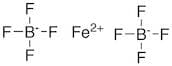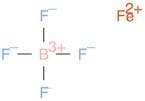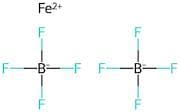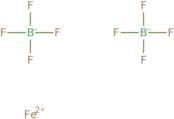
CAS 15283-51-9
:Borate(1-), tetrafluoro-, iron(2+) (2:1)
- Borate(1-), tetrafluoro-, iron(2+)
- Borate(1-), tetrafluoro-, iron(2+) (2:1)
- Ferrous fluoborate
- Ferrous fluoroborate
- Ferrous tetrafluoroborate
- Iron bis(tetrafluoroborate)
- Iron di-tetrafluoroborate
- Iron fluoborate
- Iron fluoborate (Fe(BF<sub>4</sub>)<sub>2</sub>)
- Iron fluoroborate
- Iron tetrafluoroborate
- Iron(2+) Ditetrafluoroborate
- See more synonyms
Iron(II) tetrafluoroborate, 40-45% aqueous solution
CAS:Iron(II) tetrafluoroborate, 40-45% aqueous solution
Formula:Fe(BF4)2Color and Shape:green liq.Molecular weight:229.45Iron(II) tetrafluoroborate
CAS:Formula:B2F8FePurity:.%Color and Shape:LiquidMolecular weight:229.4542Iron (II) Tetrafluoroborate, 40% aqueous solution
CAS:Iron (II) Tetrafluoroborate, 40% aqueous solutionPurity:45wt.% aqueous solutionMolecular weight:229.45g/molIron(II) tetrafluoroborate - 40-45% aqueous solution
CAS:Iron(II) tetrafluoroborate is a green-yellow crystalline solid that is soluble in water. It has been shown to have structural and optical properties that are similar to those of ferric chloride, but with the advantage of being less toxic. Iron(II) tetrafluoroborate is used as a homogeneous catalyst for organic reactions such as the hydrogenation of nitroarenes and the reduction of ketones. The catalytic activity of Iron(II) tetrafluoroborate arises from its ability to form hydrogen bonding interactions with other molecules and ions in solution.
Iron(II) tetrafluoroborate undergoes a number of reactions with other compounds, including cleavage products such as hydrogen sulfate and nitrogen atoms, which may be due to its chelate ligand. In coordination chemistry, Iron(II) tetrafluoroborate can form coordination complexes by reacting with potassium dichromate or calcium carbonate. These complexes areFormula:B2F8FePurity:About 45%Color and Shape:Slightly Green Clear LiquidMolecular weight:229.45 g/molRef: 3D-FI105721
Discontinued product