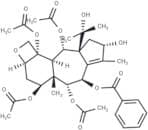
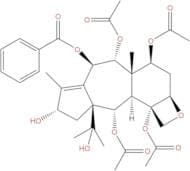
![1H-Azuleno[5',6':3,4]benz[1,2-b]oxete-4,5,6,8,10,10b(2aH)-hexol,3,4,4a,5,6,8,9,9a,10,10a-decahydro…](/_next/image/?url=https%3A%2Fstatic.cymitquimica.com%2Fcas-image%2Fthumb-webp%2F400114-1h-azuleno-5-6-34-benz-12-b-oxete-45681010b-2ah-hexol-344a-56899a-1010a-decahydro-9a-1-hydroxy-1-methylethyl-4a-7-dimethyl-451010b-tetraacetate-6-benzoate-2ar-4s-4as-5r-6r-8s-9as-10s-10ar-10bs.webp&w=3840&q=75)
CAS 153229-31-3
:1H-Azuleno[5',6':3,4]benz[1,2-b]oxete-4,5,6,8,10,10b(2aH)-hexol,3,4,4a,5,6,8,9,9a,10,10a-decahydro-9a-(1-hydroxy-1-methylethyl)-4a,7-dimethyl-,4,5,10,10b-tetraacetate 6-benzoate, (2aR,4S,4aS,5R,6R,8S,9aS,10S,10aR,10bS)-
Description:
1H-Azuleno[5',6':3,4]benz[1,2-b]oxete-4,5,6,8,10,10b(2aH)-hexol, commonly referred to by its CAS number 153229-31-3, is a complex organic compound characterized by its unique structural features, including multiple fused ring systems and hydroxyl groups. This compound belongs to a class of molecules known for their potential biological activity, often exhibiting properties such as antioxidant, anti-inflammatory, or antimicrobial effects. The presence of multiple acetyl and benzoate functional groups suggests that it may have enhanced solubility and stability, which can be advantageous in pharmaceutical applications. The stereochemistry indicated by its systematic name suggests specific spatial arrangements of atoms that can influence its reactivity and interaction with biological targets. Overall, this compound's intricate structure and functional groups make it a subject of interest in medicinal chemistry and organic synthesis, where understanding its properties can lead to the development of novel therapeutic agents.
Formula:C35H44O13
Synonyms:- 1H-Azuleno[5',6':3,4]benz[1,2-b]oxete-4,5,6,8,10,10b(2aH)-hexol,3,4,4a,5,6,8,9,9a,10,10a-decahydro-9a-(1-hydroxy-1-methylethyl)-4a,7-dimethyl-,4,5,10,10b-tetraacetate 6-benzoate, [2aR-(2aa,4b,4ab,5a,6b,8a,9ab,10a,10aa,10ba)]-
- 13-Decinnamoyltaxchinin B
- Taxayunnansin A
- Taxayuntin
Sort by
Purity (%)
0
100
|
0
|
50
|
90
|
95
|
100
Found 4 products.
Taxayunnansin A
CAS:Taxayunnansin A has anticancer activity.Formula:C35H44O13Purity:98%Color and Shape:SolidMolecular weight:672.72Taxayunnansin A
CAS:Taxayunnansin A is a diterpenoid alkaloid, which is derived from the plant Delphinium anthriscifolium var. savatieri. This compound exhibits its biological effects primarily through modulation of inflammatory pathways, potentially by interacting with specific cellular receptors and enzymes involved in inflammation. Taxayunnansin A has been studied for its anti-inflammatory properties, which are of significant interest in the treatment of inflammatory diseases. Its potential to act as a neuroprotective agent also indicates promising applications in neurodegenerative disorders. These effects are in part attributed to its influence on cellular signaling pathways that regulate cell survival and apoptosis. Current research is focused on elucidating the precise molecular mechanisms of Taxayunnansin A and exploring its efficacy in various biological models, which could pave the way for the development of new therapeutic strategies in the management of inflammation-related and neurodegenerative conditions.Formula:C35H44O13Purity:Min. 95%Molecular weight:672.7 g/mol