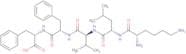
CAS 153247-40-6
:H-Lys-Leu-Val-Phe-Phe-OH
Description:
The chemical substance "H-Lys-Leu-Val-Phe-Phe-OH," with the CAS number 153247-40-6, is a synthetic peptide composed of five amino acids: lysine (Lys), leucine (Leu), valine (Val), and two phenylalanines (Phe). This peptide is characterized by its specific sequence, which influences its biological activity and interactions. The presence of the amino acid lysine at the N-terminus suggests potential for positive charge under physiological conditions, while the hydrophobic nature of leucine, valine, and phenylalanine contributes to its structural stability and potential for forming secondary structures like alpha-helices or beta-sheets. The C-terminal phenylalanine with a hydroxyl group indicates that it is a carboxamide, which may enhance solubility and stability. Peptides like this one are often studied for their roles in biological processes, including signaling pathways and as potential therapeutic agents. Their properties can be influenced by factors such as pH, temperature, and the presence of other molecules, making them important in both biochemical research and pharmaceutical applications.
Formula:C35H52N6O6
Synonyms:- Klvff
- Lys-Leu-Val-Phe-Phe
- Beta-Amyloid (16-20)
- Amyloid Beta-Protein (16-20)
- Amyloid-Beta Protein (16-20), Human, Mouse, Rat
Sort by
Purity (%)
0
100
|
0
|
50
|
90
|
95
|
100
Found 1 products.
Amyloid beta-Protein (16-20) trifluoroacetate salt
CAS:Amyloid beta-protein (Aβ) is a peptide that is associated with the development of Alzheimer's disease. The Aβ(16-20) trifluoroacetate salt (ATF) has been used in the diagnosis of Alzheimer's disease by fluorescence microscopy. This compound binds to hyaluronic acid and has been used as a coating for optical fibers and other materials, such as coatings for mitochondria for use in live cell imaging. The ATF also interacts with mitochondria and alters mitochondrial membrane potential, which may be due to its ability to displace cardiolipin from the inner mitochondrial membrane. ATF binds to unsymmetrical dimethylarginine (DMA), an endogenous nitric oxide synthase inhibitor, and selectively inhibits only cancer cells that have elevated levels of DMA. ATFP also induces spontaneous apoptosis in human carcinoma cells when bound to these cells via a photoconjugation reaction with bioconjugate chemistry.Formula:C35H52N6O6Purity:Min. 95%Molecular weight:652.82 g/mol