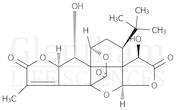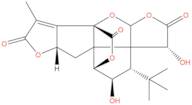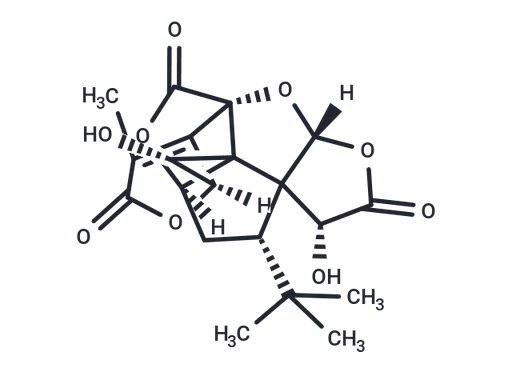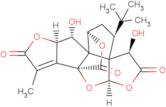
CAS 153355-70-5
:Formula:C20H22O9
InChI:InChI=1S/C20H22O9/c1-6-9-10(27-13(6)23)11(21)19-8-5-7(17(2,3)4)18(19)12(22)14(24)28-16(18)29-20(9,19)15(25)26-8/h7-8,10-12,16,21-22H,5H2,1-4H3/t7-,8+,10+,11-,12-,16-,18-,19+,20+/m0/s1
InChI key:MGXAKXRVQRODDX-LRSNRTHXSA-N
SMILES:CC1=C2[C@H]([C@@H]([C@]34[C@]25C(=O)O[C@@H]3C[C@H]([C@@]46[C@H](C(=O)O[C@H]6O5)O)C(C)(C)C)O)OC1=O
Filter by
Purity percentage
0
100
|
0
|
50
|
90
|
95
|
100
Found 7 products.
- Lower prices
- Higher prices
- Lower purities
- Higher purities
- Faster estimated delivery
Ginkgolide K (Standard)
CAS:Ginkgolide K (Standard) is a reference standard for research and analysis in studies involving Ginkgolide K. Ginkgolide K induces protective autophagy through the AMPK/mTOR/ULK1 signalling pathway. It possesses neuroprotective activity.Formula:C20H22O9Color and Shape:SolidMolecular weight:406.38Ginkgolide K
CAS:Ginkgolide K induces protective autophagy through the AMPK/mTOR/ULK1 signalling pathway. It possesses neuroprotective activity.Formula:C20H22O9Purity:99.44% - 99.72%Color and Shape:SolidMolecular weight:406.38Ginkgolide K
CAS:Ginkgolide K is a natural compound that has been shown to have neurotrophic effects. It has been found to have GSH-px activities, which are the ability to protect neurons from death by oxidative stress. Ginkgolide K also activates apoptotic pathways such as mitochondrial membrane potential and cell lysis, and inhibits the inflammatory response caused by LPS in fetal bovine cells. It has been shown to inhibit P-gp, which may be an effect of its gsh-px activity. Ginkgolide K has also been shown to affect cell signaling pathways and M2 phenotype in vitro.Formula:C20H22O9Purity:Min. 95%Molecular weight:406.4 g/mol