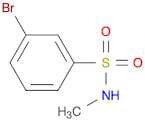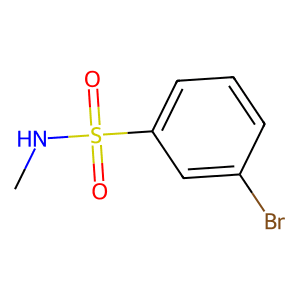
CAS 153435-79-1
:3-BROMO-N-METHYLBENZENESULPHONAMIDE
Description:
3-Bromo-N-methylbenzenesulphonamide is an organic compound characterized by the presence of a bromine atom, a methyl group, and a sulphonamide functional group attached to a benzene ring. The bromine substituent is located at the meta position relative to the sulphonamide group, which influences the compound's reactivity and solubility. The sulphonamide group contributes to the compound's potential biological activity, as sulphonamides are known for their antibacterial properties. This compound is typically a solid at room temperature and may exhibit moderate solubility in polar solvents due to the presence of the sulphonamide functional group. Its molecular structure suggests potential applications in medicinal chemistry, particularly in the development of pharmaceuticals. Additionally, the presence of the bromine atom may enhance the compound's reactivity in various chemical reactions, making it a useful intermediate in organic synthesis. Safety data should be consulted for handling and storage, as with all chemical substances, to ensure proper precautions are taken.
Formula:C7H8BrNO2S
InChI:InChI=1/C7H8BrNO2S/c1-9-12(10,11)7-4-2-3-6(8)5-7/h2-5,9H,1H3
SMILES:CNS(=O)(=O)c1cccc(c1)Br
Synonyms:- N-Methyl 3-Bromobenzenesulfonamide
- 3-Bromo-N-methylbenzenesulphonamide 98%
- 3-bromo-N-methylbenzenesulfonamide
Sort by
Purity (%)
0
100
|
0
|
50
|
90
|
95
|
100
Found 4 products.
N-Methyl 3-bromobenzenesulfonamide
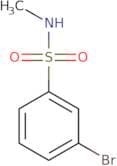
CAS:Formula:C7H8BrNO2SPurity:98%Color and Shape:SolidMolecular weight:250.11293-Bromo-N-methylbenzenesulphonamide
CAS:3-Bromo-N-methylbenzenesulphonamideFormula:C7H8BrNO2SPurity:98%Color and Shape: white solidMolecular weight:250.11g/mol3-Bromo-N-methylbenzenesulfonamide
CAS:Formula:C7H8BrNO2SPurity:98%Color and Shape:SolidMolecular weight:250.11N-Methyl 3-bromobenzenesulfonamide
CAS:N-Methyl 3-bromobenzenesulfonamide is a room-temperature ionic liquid that is soluble in ethyl acetate, water and other organic solvents. It reacts with an iridium complex to form the active catalyst. The catalyst can be used for the synthesis of 6-chloropurine from ethyl acetate and ammonia at atmospheric pressure at room temperature. The reaction system is catalytic, bifunctional and can be used to produce a variety of organic compounds that are useful for chemists, such as pharmaceuticals and agrochemicals.
Formula:C7H8BrNO2SPurity:Min. 95%Molecular weight:250.11 g/molRef: 3D-DGA43579
Discontinued product