CAS 15366-65-1
:5-IODONICOTINIC ACID
Description:
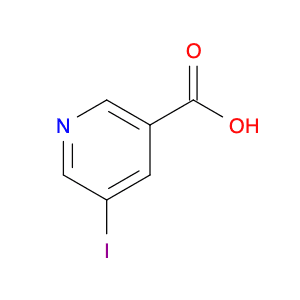
5-Iodononicotinic acid is a chemical compound that belongs to the class of heterocyclic aromatic compounds, specifically a derivative of nicotinic acid. It features an iodine atom substituted at the 5-position of the pyridine ring, which contributes to its unique reactivity and properties. This compound is characterized by its ability to participate in various chemical reactions, including electrophilic substitutions and coupling reactions, due to the presence of both the carboxylic acid and the iodine functional groups. It is typically used in organic synthesis and medicinal chemistry, where it may serve as an intermediate in the preparation of biologically active molecules. The presence of the iodine atom can enhance the compound's lipophilicity and influence its biological activity. Additionally, 5-iodonicotinic acid may exhibit properties such as solubility in polar solvents and potential applications in pharmaceuticals, particularly in the development of new therapeutic agents. Safety and handling precautions should be observed, as with any chemical substance, to mitigate risks associated with its use.
Formula:C6H4INO2
InChI:InChI=1/C6H4INO2/c7-5-1-4(6(9)10)2-8-3-5/h1-3H,(H,9,10)
SMILES:c1c(cncc1I)C(=O)O
Synonyms:- 5-Iodopyridine-3-Carboxylic Acid
Sort by
Purity (%)
0
100
|
0
|
50
|
90
|
95
|
100
Found 4 products.
5-iodopyridine-3-carboxylic acid
CAS:5-Iodopyridine-3-carboxylic acid is a monoclonal antibody that binds to the epidermal growth factor receptor. It is used in vitro and in vivo as a tool for identifying the epidermal growth factor receptor and its interaction with other proteins. 5-Iodopyridine-3-carboxylic acid has been shown to have high affinity for the epidermal growth factor receptor, and it can be used to identify the presence of this receptor on cells or tissues. The compound has also been conjugated to different molecules, such as carboxylates, which can be used to study their effects on cell uptake.Formula:C6H4INO2Purity:Min. 95%Molecular weight:249 g/mol