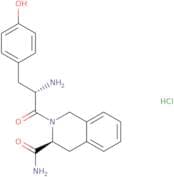
CAS 154121-70-7
:H-Tyr-L-1,2,3,4-tetrahydroisoquinoline-3-carboxamide . HCl
Description:
H-Tyr-L-1,2,3,4-tetrahydroisoquinoline-3-carboxamide hydrochloride, with the CAS number 154121-70-7, is a chemical compound that features a tetrahydroisoquinoline core, which is a bicyclic structure known for its presence in various biologically active molecules. This compound is characterized by the presence of a carboxamide functional group and a tyrosine (Tyr) residue, indicating its potential role in biological systems, particularly in neurotransmitter activity and receptor interactions. The hydrochloride salt form enhances its solubility in aqueous solutions, making it suitable for various applications in biochemical research and pharmaceutical development. Its structural features suggest potential interactions with biological targets, which may be of interest in the study of neuropharmacology and medicinal chemistry. As with many compounds of this nature, it is essential to handle it with care, adhering to safety protocols, and to conduct further studies to fully elucidate its properties and potential applications.
Formula:C19H21N3O3
Synonyms:- H-Tyr-Tic-NH2 . HCl
Sort by
Purity (%)
0
100
|
0
|
50
|
90
|
95
|
100
Found 1 products.
H-Tyr-L-1,2,3,4-tetrahydroisoquinoline-3-carboxamide·HCl
CAS:H-Tyr-L-1,2,3,4-tetrahydroisoquinoline-3-carboxamide·HCl is a monoclinic crystalline compound. It has a molecular weight of 607.14 and contains the dipeptide Tyr-Lys in its structure. H-Tyr-L-1,2,3,4-tetrahydroisoquinoline-3-carboxamide·HCl crystallizes in the P21/c space group and has an asymmetric unit cell with dimensions a=8.851 Å, b=7.965 Å and c=5.98 Å. This compound has been shown to have antibacterial properties against methicillin resistant Staphylococcus aureus (MRSA) isolates and Clostridium perfringens strains by inhibiting bacterial protein synthesis through inhibition of peptidyl transferase activity.Formula:C19H21N3O3·HClPurity:Min. 95%Molecular weight:375.85 g/mol