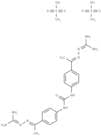
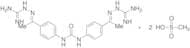
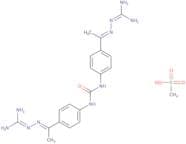
![1,3-bis(4-{(1E)-1-[(diaminomethylidene)hydrazinylidene]ethyl}phenyl)urea methanesulfonate (1:2)](/_next/image/?url=https%3A%2Fstatic.cymitquimica.com%2Fcas-image%2Fthumb-webp%2F383308-13-bis-4-1e-1-diaminomethylidene-hydrazinylidene-ethyl-phenyl-urea-methanesulfonate-1-2.webp&w=3840&q=75)
CAS 15427-93-7
:1,3-bis(4-{(1E)-1-[(diaminomethylidene)hydrazinylidene]ethyl}phenyl)urea methanesulfonate (1:2)
Description:
1,3-bis(4-{(1E)-1-[(diaminomethylidene)hydrazinylidene]ethyl}phenyl)urea methanesulfonate (1:2), with CAS number 15427-93-7, is a complex organic compound characterized by its unique structural features, including multiple functional groups that contribute to its reactivity and solubility. This substance contains urea and methanesulfonate moieties, which enhance its potential applications in various fields, including pharmaceuticals and agrochemicals. The presence of hydrazine derivatives suggests potential biological activity, possibly as a precursor for further chemical transformations or as an active pharmaceutical ingredient. The compound's solubility in polar solvents is likely due to the methanesulfonate group, which can facilitate interactions with biological systems. Additionally, the presence of multiple aromatic rings may contribute to its stability and potential for π-π stacking interactions. Overall, this compound's intricate structure and functional diversity make it a subject of interest for research in medicinal chemistry and materials science.
Formula:C21H32N10O7S2
InChI:InChI=1/C19H24N10O.2CH4O3S/c1-11(26-28-17(20)21)13-3-7-15(8-4-13)24-19(30)25-16-9-5-14(6-10-16)12(2)27-29-18(22)23;2*1-5(2,3)4/h3-10H,1-2H3,(H4,20,21,28)(H4,22,23,29)(H2,24,25,30);2*1H3,(H,2,3,4)/b26-11+,27-12+;;
Sort by
Purity (%)
0
100
|
0
|
50
|
90
|
95
|
100
Found 3 products.
NSC 109555
CAS:NSC 109555 is a selective, reversible, ATP-competitive Chk2 inhibitor (IC50 = 0.2 μM) that displays no effect on a range of other kinases including Chk1 (IC50Formula:C21H32N10O7S2Color and Shape:SolidMolecular weight:600.67NSC 109555
CAS:Controlled ProductApplications NSC 109555 is an inhibitor of checkpoint kinase 2 (Chk2), a serine/threonine kinase involved in the ATM-Chk2 checkpoint pathway. Drugs that target Chk2 in combination with DNA-damaging agents can be beneficial in cancer therapy. Studies in mice, rats, rabbits, dogs, and monkeys have shown that NSC 109555 displays toxic effects. A singe injection of the drug at a concentration of 12.5-25 mg/kg caused acute paralysis leading to apnea and death.
References Lountos, G. et al.: Protein Sci., 18, 92 (2009); Mihich, E. et al.: Canc. Res., 29, 1056 (1969)Formula:C19H24N10O·2C7H8O3SColor and Shape:NeatMolecular weight:752.864NSC109555
CAS:NSC109555 is a small molecule that is chemically synthesized. It has been shown to inhibit the uptake of sodium citrate by mitochondria, which inhibits cellular energy production. NSC109555 also has anti-cancer properties and may be used as a diagnostic agent for cancer. It is activated when it binds to DNA as a template and prevents the formation of dna strands, which prevents the replication of cells. NSC109555 can also cross cell membranes and enter into cells, where it prevents repair mechanisms such as DNA repair from occurring. The chemical structure of this drug is not yet known, but its mechanism of action may involve the response pathway in cancer cells that regulates cell cycle progression, gene expression, and apoptosis.Formula:C19H24N10O·2CH3SO3HPurity:Min. 95%Molecular weight:600.67 g/mol